Depth
Chlorophthalmus · Bony Fish

Shortnose Greeneye

Chlorophthalmus agassizi

50-1000m
Depth Range
25cm
Max Size
Mediterranean
Distribution
50-1000m
Depth Range
25cm
Max Size
Deep water
Habitat
Carnivore
Diet
Small groups
Social
LC
IUCN Status
Rare
Sighting Likelihood
KingdomAnimalia
PhylumChordata
ClassActinopterygii
GenusChlorophthalmus
Speciesagassizi

Identification & Biology

  • IdentificationSmall, elongated body with very large, bright green eyes. Silver-grey body with a slightly translucent quality. Short, blunt snout. Single dorsal fin.
  • SizeUp to 24 cm total length, commonly 10 to 16 cm.
  • Social HabitSchooling in deep water, forming aggregations near the seabed on the continental slope.
  • HabitatDeep-water muddy bottoms on the continental slope.
  • Depth200 to 1,000 m, most common between 200 and 600 m.
  • Feeds OnZooplankton and small crustaceans in the deep-water column.
  • DistributionEastern Atlantic from Portugal to West Africa, including the Mediterranean Sea.
  • DescriptionNamed for its striking bright green eyes, this deep-water fish is never seen by recreational divers. The green colour of the eyes may help filter the faint bioluminescent light that penetrates its deep-water habitat. Occasionally caught as bycatch in deep trawls.

Habitat & Distribution

A deep-water species found from 50 to 1000 m, most common between 200 and 500 m on the upper continental slope. Inhabits muddy and sandy-mud substrates.

Where Malta divers have spotted this species

Loading…

Sightings are logged by divers using our What Did You See? dive-log tool. View the full live sightings map.

Detail

Preferred Environment

Prefers the muddy bottoms of the upper and mid continental slope. Often found in aggregations near the seabed in dimly lit deep-water environments.

Encounter Tips

Best approached slowly and calmly. Avoid casting shadows directly over the animal. Neutral buoyancy and patience increase encounter success significantly.
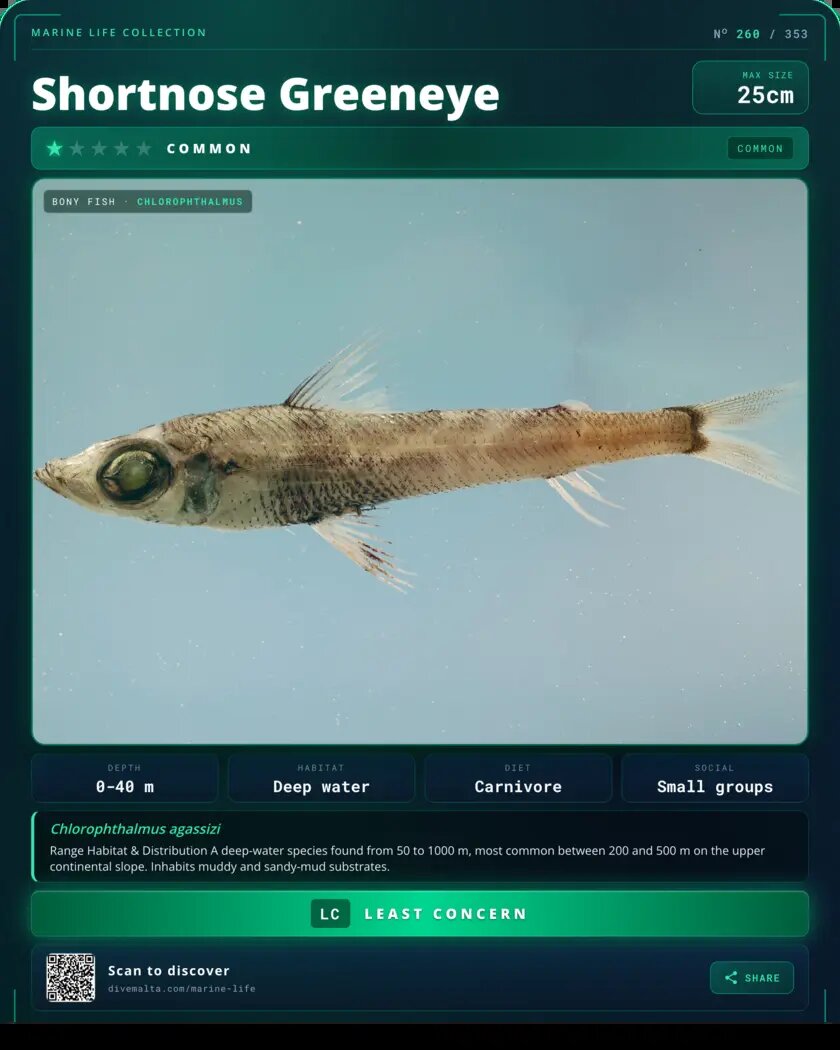
Shortnose Greeneye species card

Behaviour & Diet

Feeding Strategy

Feeds on small crustaceans, worms, and other benthic invertebrates near the seabed. Its large eyes are adapted for detecting prey in low-light conditions.

Deep benthic feeder

Reproduction

Spawning occurs in deep water. Eggs are thought to be pelagic, rising to shallower depths for larval development before juveniles descend to adult habitats.

Deep spawner

Behaviour & Defence

The reflective green eyes may serve to disorient predators in low light. Its small size and deep habitat also reduce encounter rates with many predators.

Low-light camouflage

Where to Encounter in Malta

Dive sites where Chlorophthalmus agassizi may be encountered will be added as sighting data is collected.

IUCN Red ListLeast Concern

Conservation Status

This species is assessed as Least Concern on the IUCN Red List. Mediterranean populations face ongoing pressure from fishing activity, habitat degradation, and climate-driven changes.

Source: IUCN Red List
diveshack Mediterranean Marine Life guide