Depth
Acantholabrus · Bony Fish

Scale-rayed Wrasse

Acantholabrus palloni

30 - 200 m
Depth Range
25 cm
Max Size
Mediterranean
Distribution
30 - 200 m
Depth Range
25 cm
Max Size
Deep Reefs
Habitat
Carnivore
Diet
Solitary
Social
LC
IUCN Status
Moderate
Sighting Likelihood
KingdomAnimalia
PhylumChordata
ClassActinopterygii
GenusAcantholabrus
Speciespalloni

Identification & Biology

  • IdentificationMedium-sized wrasse with a deep, compressed body. Brown to olive-green with a pattern of paler spots and darker bars. Scales on the dorsal and anal fin rays are distinctive.
  • SizeUp to 25 cm total length, commonly 15 to 20 cm.
  • Social HabitSolitary and somewhat reclusive. Found near deep rocky structures rather than open reef.
  • HabitatDeep rocky reefs, boulder fields, and walls. Prefers areas with structural complexity at moderate to deep depths.
  • Depth15 to 200 m, most common between 30 and 100 m.
  • Feeds OnCrustaceans, molluscs, and other invertebrates picked from rock surfaces.
  • DistributionEastern Atlantic from Norway to Morocco, including the Mediterranean Sea.
  • DescriptionA deep-water wrasse that is rarely seen by recreational divers due to its preference for depths beyond 30 m. Its name refers to the scales that extend onto the bases of its dorsal and anal fin rays, a feature unique among Mediterranean wrasses.

Habitat & Distribution

A deep-water wrasse found on rocky bottoms from 30 to 200 m depth across the Mediterranean. One of the deeper-dwelling wrasses in the region, typically associated with coralligenous assemblages and rocky outcrops.

Where Malta divers have spotted this species

Loading…

Sightings are logged by divers using our What Did You See? dive-log tool. View the full live sightings map.

Detail

Preferred Environment

Rocky substrates at mesophotic to deep zone depths. Found on coralligenous formations, deep reef walls, and boulder fields. Prefers areas with structural complexity and some current flow.

Encounter Tips

Encountered on deeper dive sites, typically below 30 m. Look along deep reef walls and rocky outcrops. Technical divers may encounter this species on deeper coralligenous habitats.
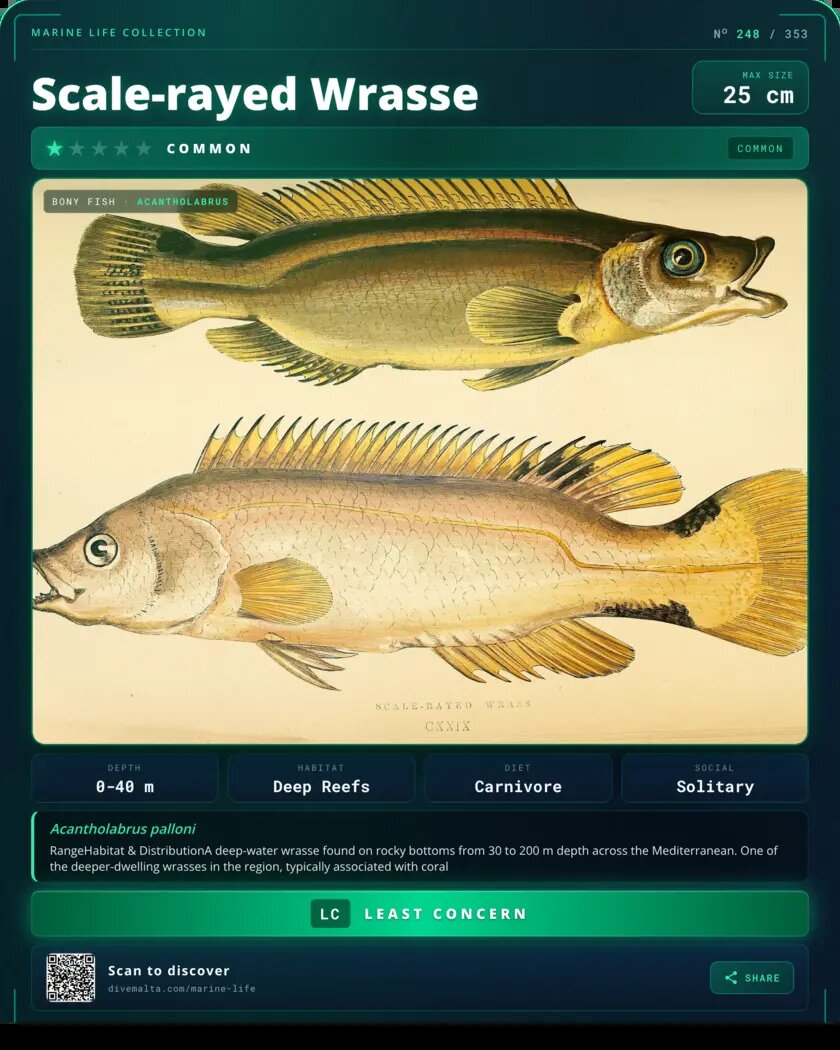
Scale-rayed Wrasse species card

Where to Encounter in Malta

Dive sites where Acantholabrus palloni may be encountered will be added as sighting data is collected.

IUCN Red ListLeast Concern

Conservation Status

This species is assessed as Least Concern on the IUCN Red List. Mediterranean populations face ongoing pressure from fishing activity, habitat degradation, and climate-driven changes.

Source: IUCN Red List
diveshack Mediterranean Marine Life guide