Depth
Arnoglossus · Bony Fish

Scaldfish

Arnoglossus spp.

10-200m
Depth Range
20cm
Max Size
Mediterranean
Distribution
10-200m
Depth Range
20cm
Max Size
Sandy
Habitat
Carnivore
Diet
Solitary
Social
LC
IUCN Status
Rare
Sighting Likelihood
Kingdom Animalia
Phylum Chordata
Class Actinopterygii
Genus Arnoglossus
Species spp.

Identification & Biology

  • IdentificationSmall, very thin, transparent flatfish with both eyes on the left side. Body is pale, almost transparent, with faint brownish mottling. Extremely delicate and flattened.
  • SizeUp to 19 cm total length, commonly 8 to 14 cm.
  • Social HabitSolitary and bottom-dwelling. Lies flat on sandy and muddy substrates.
  • HabitatSandy and muddy bottoms from shallow coastal waters to the continental shelf.
  • Depth10 to 200 m, most common between 20 and 100 m.
  • Feeds OnSmall crustaceans and worms found on the seabed surface.
  • DistributionEastern Atlantic from the British Isles to Morocco, including the Mediterranean Sea.
  • DescriptionAn extremely thin, almost transparent flatfish that is virtually invisible against the sandy substrate. Named 'scaldfish' because its scales are so delicate they fall off at the slightest touch, leaving the skin looking scalded. One of the most cryptic fish on Mediterranean sandy bottoms.

Habitat & Distribution

Found on soft, sandy and muddy substrates across the Mediterranean from around 10m to 200m depth. Most common on the outer continental shelf over fine sand and silt.

Where Malta divers have spotted this species

Loading…

Sightings are logged by divers using our What Did You See? dive-log tool. View the full live sightings map.

Detail

Preferred Environment

Prefers sandy and muddy seabeds where it lies partially buried and well camouflaged. Most frequently encountered by divers over open sand patches in the 10-40m range.

Encounter Tips

Best approached slowly and calmly. Avoid casting shadows directly over the animal. Neutral buoyancy and patience increase encounter success significantly.
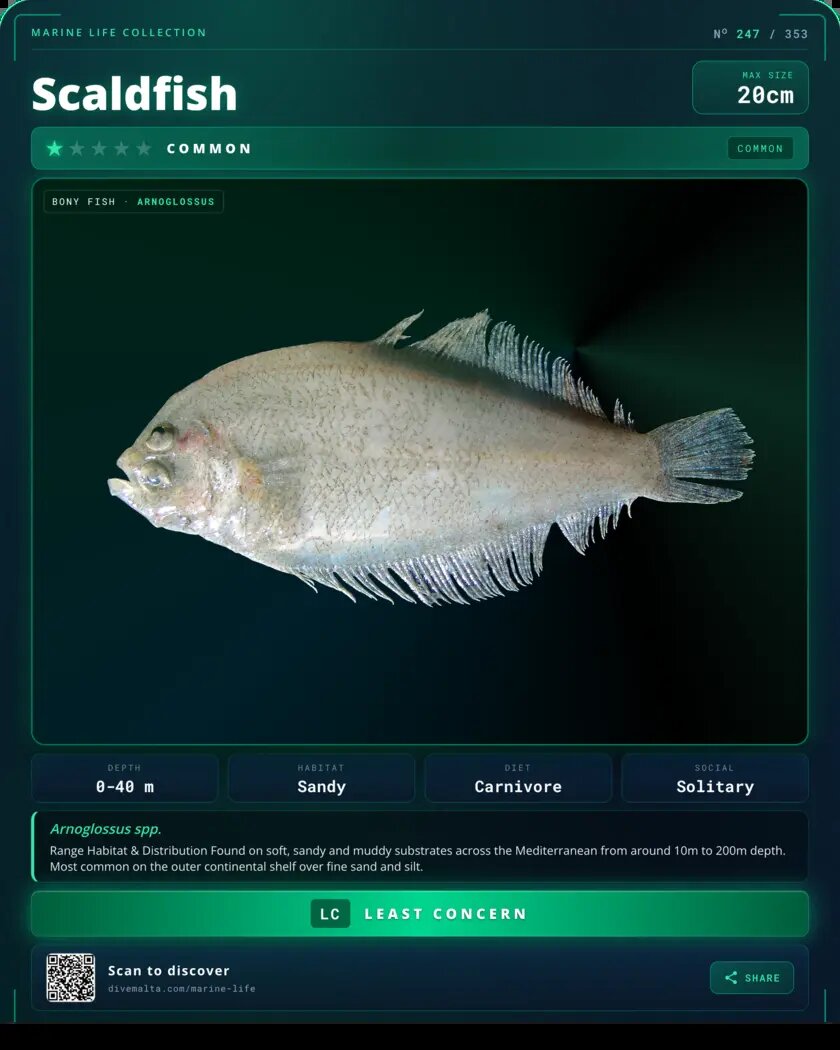
Scaldfish species card

Behaviour & Diet

Feeding Strategy

A small carnivore that feeds on tiny crustaceans, polychaete worms, and other benthic invertebrates disturbed from the sand.

Benthic predator

Reproduction

Spawns pelagic eggs in open water during spring and summer. Larvae are symmetrical and transition to flatfish form as they settle to the seabed.

Pelagic spawner

Behaviour & Defence

Exceptional camouflage allows it to vanish against the sandy seabed. Can change skin colour to match the surrounding substrate within seconds.

Camouflage master

Where to Encounter in Malta

Dive sites where Arnoglossus spp. may be encountered will be added as sighting data is collected.

IUCN Red List Least Concern

Conservation Status

This species is assessed as Least Concern on the IUCN Red List. Mediterranean populations face ongoing pressure from fishing activity, habitat degradation, and climate-driven changes.

Source: IUCN Red List
diveshack Mediterranean Marine Life guide