Depth
Sarpa · Bony Fish

Salema

Sarpa salpa

0-40m
Depth Range
Variable
Max Size
Mediterranean
Distribution
0-40m
Depth Range
Variable
Max Size
Sandy / Muddy
Habitat
Photosynthetic
Diet
Solitary
Social
LC
IUCN Status
Kingdom Animalia
Phylum Chordata
Class Actinopterygii
Genus Sarpa
Species salpa

Identification & Biology

  • IdentificationElongated, oval body with 10 to 11 distinctive golden-yellow longitudinal stripes on a silver-blue body. Large eyes with a golden tint. Small, downturned mouth suited to grazing.
  • SizeUp to 51 cm total length, commonly 15 to 30 cm.
  • Social HabitHighly gregarious, forming large schools that move slowly over rocky reefs and seagrass beds, grazing as they go.
  • HabitatRocky reefs, seagrass meadows, and mixed substrates. One of the few heavily herbivorous Mediterranean fish.
  • Depth1 to 70 m, most common between 3 and 20 m.
  • Feeds OnAlgae and seagrass. One of the Mediterranean's primary herbivorous fish species.
  • DistributionEastern Atlantic from the Bay of Biscay to South Africa, including the entire Mediterranean Sea.
  • DescriptionA distinctive, gold-striped seabream that is one of the few truly herbivorous fish in the Mediterranean. Schools of salema graze slowly over rocky reefs like underwater sheep. Interestingly, salema are known to cause hallucinogenic effects when consumed, due to toxins accumulated from certain algae in their diet.

Habitat & Distribution

Found across the Mediterranean, inhabiting sandy / muddy environments. Active from the surface down to 40m depth.

Where Malta divers have spotted this species

Loading…

Sightings are logged by divers using our What Did You See? dive-log tool. View the full live sightings map.

Detail

Preferred Environment

Sandy / Muddy habitats, typically at depths of 0-40m. Most commonly encountered by divers at the shallower end of its range.

Encounter Tips

Best approached slowly and calmly. Avoid casting shadows directly over the animal. Neutral buoyancy and patience increase encounter success significantly.
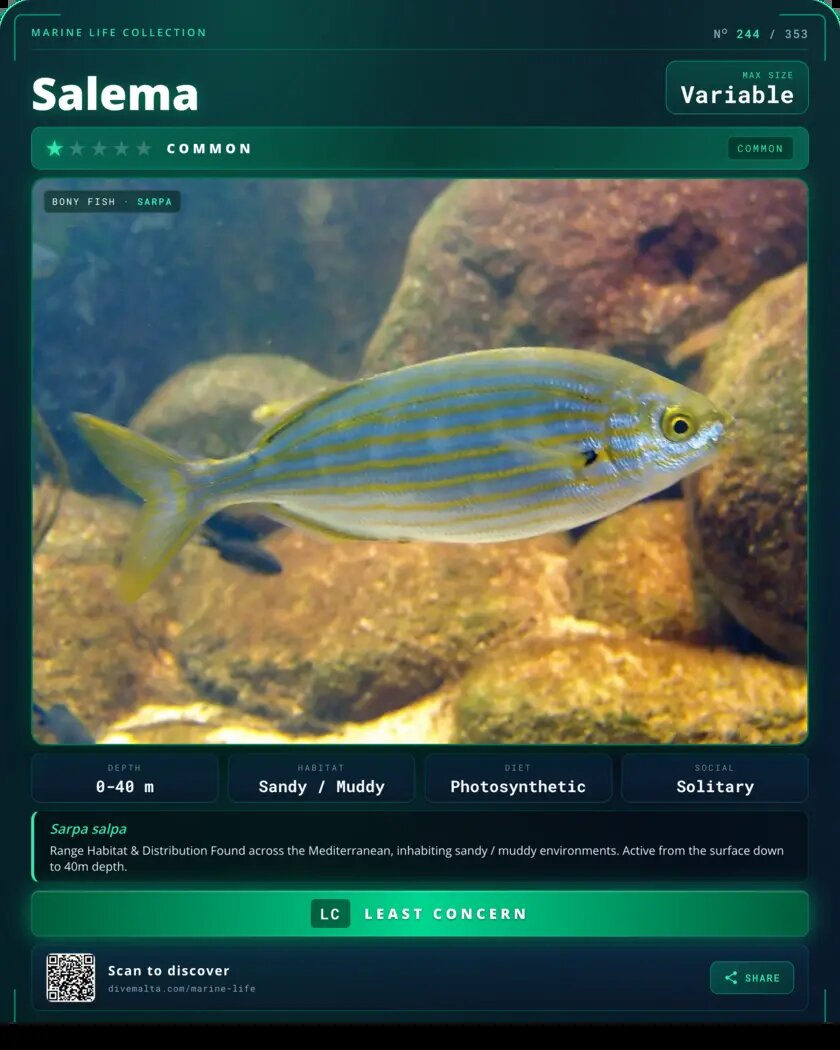
Salema species card

Behaviour & Diet

Feeding Strategy

One of the few truly herbivorous Mediterranean fish, grazing almost exclusively on algae and Posidonia seagrass.

Herbivore

Reproduction

Spawns pelagic eggs in spring. Juveniles settle inshore among rocky shallows and seagrass beds.

Pelagic spawner

Behaviour & Defence

Forms large, dense schools that create visual confusion for predators. Golden lateral stripes may serve as disruptive patterning.

Schooling

Where to Encounter in Malta

The following dive sites offer strong habitat match for Sarpa salpa. All are accessible on a guided dive with diveshack.

3-18m
Comino

Blue Lagoon

Extensive sandy floor with excellent visibility. A prime habitat for benthic species that shelter in the sandy channels.

View dive site ›
5-22m
South Malta

Ghar Lapsi

Sheltered cove with sandy patches between rocky outcrops. The sandy areas at 8-15m are rich in benthic marine life.

View dive site ›
8-30m
North Malta

Cirkewwa

Sandy channels flanking the reef system provide excellent habitat for bottom-dwelling species.

View dive site ›
IUCN Red List Least Concern

Conservation Status

This species is assessed as Least Concern on the IUCN Red List. Mediterranean populations face ongoing pressure from fishing activity, habitat degradation, and climate-driven changes to prey availability.

Source: iNaturalist Guide #888
by Lesley Clements (CC BY-SA)
diveshack Mediterranean Marine Life guide