Depth
Carapus · Bony Fish

Pearl Fish

Carapus acus

10-150m
Depth Range
20cm
Max Size
Mediterranean
Distribution
10-150m
Depth Range
20cm
Max Size
Sandy / Symbiotic
Habitat
Carnivore
Diet
Solitary
Social
LC
IUCN Status
Rare
Sighting Likelihood
KingdomAnimalia
PhylumChordata
ClassActinopterygii
GenusCarapus
Speciesacus

Identification & Biology

  • IdentificationExtremely slender, elongated, translucent body tapering to a fine point. Pale, semi-transparent with a silvery sheen. No pelvic fins. Tail is pointed rather than forked.
  • SizeUp to 20 cm total length, commonly 10 to 15 cm.
  • Social HabitSolitary. Famous for its commensal relationship with sea cucumbers, living inside their body cavity.
  • HabitatInside the body cavity of sea cucumbers. Also found in the cavities of starfish and bivalve molluscs. Exits its host at night to feed.
  • Depth5 to 50 m, wherever suitable host sea cucumbers occur.
  • Feeds OnSmall crustaceans and other invertebrates caught outside the host at night. Some species may also feed on host internal organs.
  • DistributionEastern Atlantic and Mediterranean Sea.
  • DescriptionOne of the most bizarre fish in the Mediterranean. The pearlfish enters its sea cucumber host tail-first through the anus and lives inside the body cavity during the day, emerging at night to feed. This is one of the most fascinating examples of commensalism in Mediterranean marine life. Very rarely seen by divers unless a sea cucumber is examined closely.

Habitat & Distribution

Found over sandy and muddy substrates from 10 to 150 m depth, wherever suitable sea cucumber hosts are present. Most common on soft sediment areas of the Mediterranean shelf.

Where Malta divers have spotted this species

Loading…

Sightings are logged by divers using our What Did You See? dive-log tool. View the full live sightings map.

Detail

Preferred Environment

Requires the presence of holothurian (sea cucumber) hosts. Sandy plains and seagrass meadow edges where sea cucumbers are abundant are the primary habitats.

Encounter Tips

Best approached slowly and calmly. Avoid casting shadows directly over the animal. Neutral buoyancy and patience increase encounter success significantly.
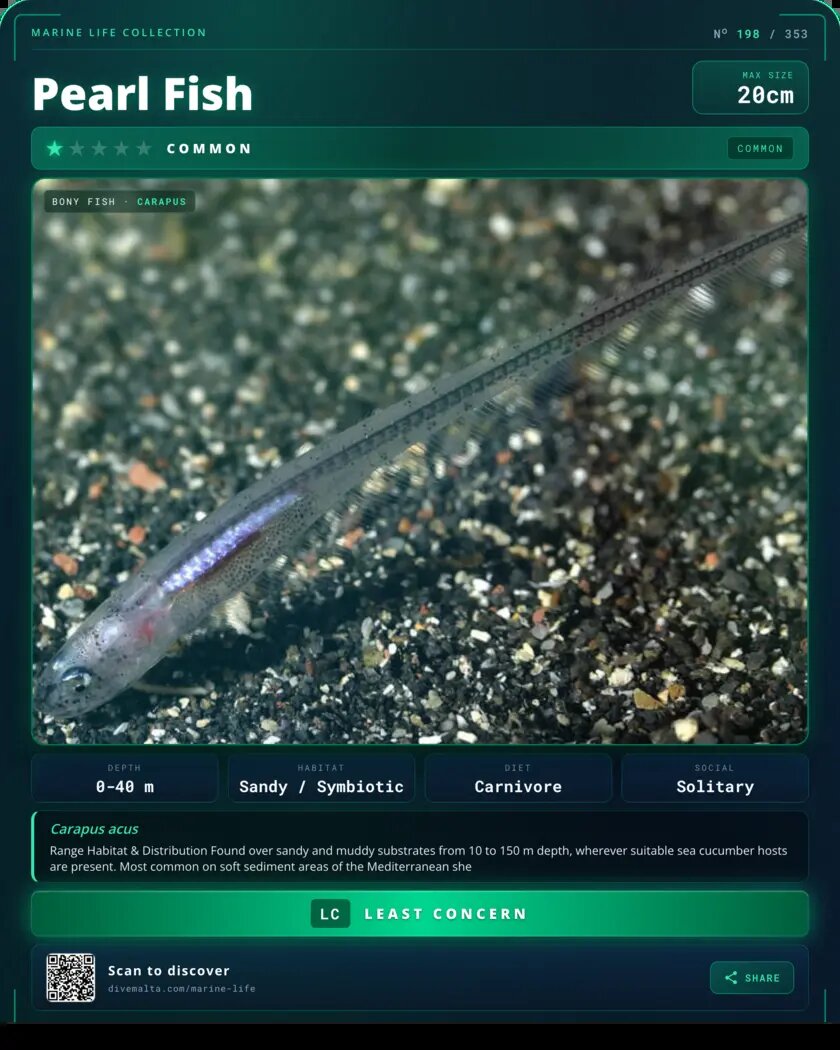
Pearl Fish species card

Behaviour & Diet

Feeding Strategy

Feeds on small crustaceans and other invertebrates outside its host, typically hunting at night. Some species are also known to consume the internal organs of their host.

Nocturnal feeder

Reproduction

Eggs are released in open water in a gelatinous mass. Larvae go through a distinctive vexillifer stage with elongated dorsal fin rays before settling and seeking a host.

Pelagic larvae

Behaviour & Defence

Retreats tail-first into its sea cucumber host when threatened. The translucent body provides camouflage over sandy substrates when outside the host.

Host shelter

Where to Encounter in Malta

Dive sites where Carapus acus may be encountered will be added as sighting data is collected.

IUCN Red List Least Concern

Conservation Status

This species is assessed as Least Concern on the IUCN Red List. Mediterranean populations face ongoing pressure from fishing activity, habitat degradation, and climate-driven changes.

Source: IUCN Red List
diveshack Mediterranean Marine Life guide