Depth
Thalassoma · Bony Fish

Ornate Wrasse

Thalassoma pavo

1-150m
Depth Range
Variable
Max Size
Mediterranean
Distribution
1-150m
Depth Range
Variable
Max Size
Rocky Reef
Habitat
Carnivore
Diet
Solitary
Social
LC
IUCN Status
High
Sighting Likelihood
Kingdom Animalia
Phylum Chordata
Class Actinopterygii
Genus Thalassoma
Species pavo

Identification & Biology

  • IdentificationMedium-sized wrasse with a beautiful, complex colour pattern. Males have a green head with blue lines, orange-red bands on the body, and a blue-edged dark spot behind the pectoral fin. Females are brown with a pale belly.
  • SizeUp to 25 cm total length, commonly 12 to 18 cm.
  • Social HabitFound in small harems of one dominant male with several females. Males are territorial and conspicuous.
  • HabitatRocky reefs, boulder fields, and seagrass bed edges. Prefers warm, clear water with good visibility.
  • Depth1 to 50 m, most common between 3 and 20 m.
  • Feeds OnSmall invertebrates including crustaceans, molluscs, worms, and sea urchins. Also acts as a cleaner fish.
  • DistributionMediterranean Sea and adjacent Atlantic coast from Portugal to West Africa.
  • DescriptionArguably the most colourful wrasse in the Mediterranean, the ornate wrasse is a perennial favourite of underwater photographers. Males flash vivid green, blue, orange, and red as they patrol their territories. It is a cleaner fish, sometimes picking parasites from larger species. A protogynous hermaphrodite that changes from the plain female phase to the spectacular male phase.

Habitat & Distribution

Found across the Mediterranean, inhabiting rocky reef environments. Active from the surface down to 150m depth.

Where Malta divers have spotted this species

Loading…

Sightings are logged by divers using our What Did You See? dive-log tool. View the full live sightings map.

Detail

Preferred Environment

Rocky Reef habitats, typically at depths of 1-150m. Most commonly encountered by divers at the shallower end of its range.

Encounter Tips

Best approached slowly and calmly. Avoid casting shadows directly over the animal. Neutral buoyancy and patience increase encounter success significantly.
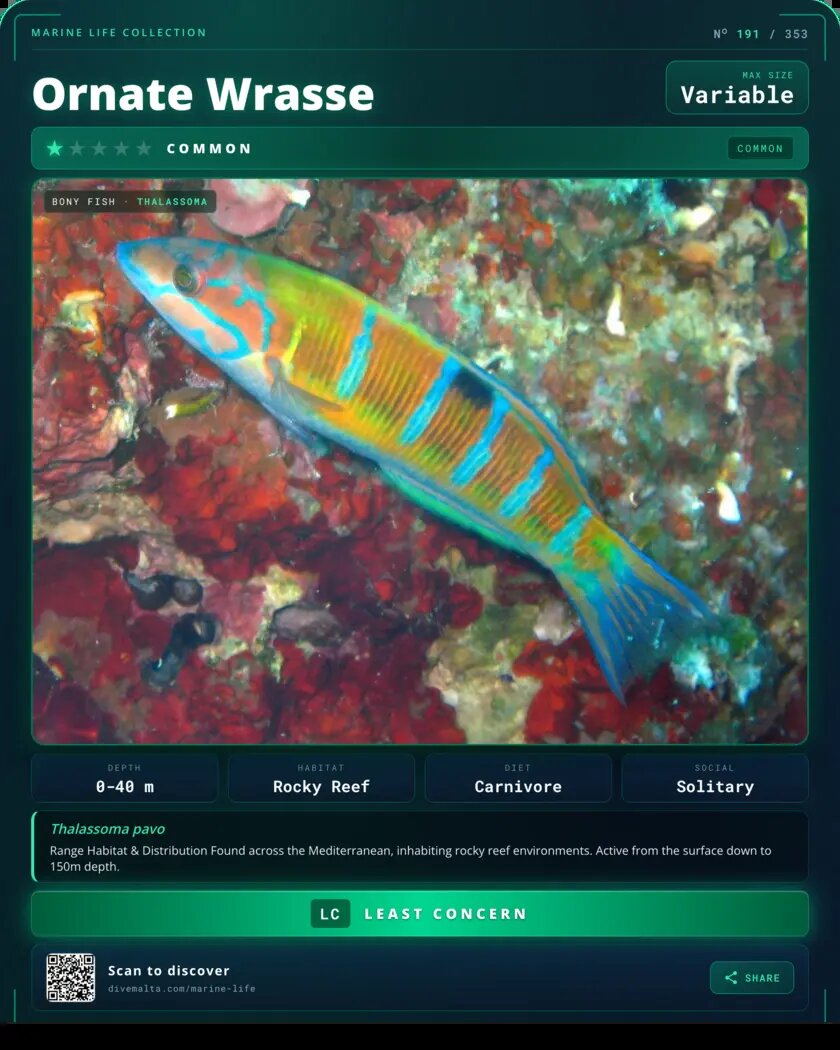
Ornate Wrasse species card

Behaviour & Diet

Feeding Strategy

Hunts small invertebrates, crustaceans and worms among rocks and algae, using its protrusible mouth to pick prey from crevices.

Benthic forager

Reproduction

A protogynous hermaphrodite: females can change sex to male. Dominant males display vivid colours during courtship and spawning occurs in open water.

Hermaphrodite

Behaviour & Defence

Buries itself in sand at night and when threatened, disappearing almost instantly beneath the substrate.

Sand burial

Where to Encounter in Malta

The following dive sites offer strong habitat match for Thalassoma pavo. All are accessible on a guided dive with diveshack.

5-30m
North Malta

Cirkewwa

Rocky reef with caves, arches and ledges hosting a rich diversity of reef species.

View dive site ›
5-50m
Gozo

Blue Hole

One of the Med's most famous reef dive sites. Rocky walls and archways covered in life.

View dive site ›
18-36m
South Malta

Um El Faroud

The wreck lies on a sandy bottom surrounded by rocky reef -- a diverse habitat attracting reef species.

View dive site ›
IUCN Red List Least Concern

Conservation Status

This species is assessed as Least Concern on the IUCN Red List. Mediterranean populations face ongoing pressure from fishing activity, habitat degradation, and climate-driven changes to prey availability.

Source: iNaturalist Guide #888
by Lesley Clements (CC BY-SA)
diveshack Mediterranean Marine Life guide