Depth
Mola · Bony Fish

Ocean Sunfish

Mola mola

0-40m
Depth Range
Variable
Max Size
Mediterranean
Distribution
0-40m
Depth Range
Variable
Max Size
Reef & Open
Habitat
Carnivore
Diet
Solitary
Social
LC
IUCN Status
Rare
Sighting Likelihood
Kingdom Animalia
Phylum Chordata
Class Actinopterygii
Genus Mola
Species mola

Identification & Biology

  • IdentificationUnmistakable, massive, disc-shaped body that appears to be all head with no tail. Grey to blue-grey, rough sandpaper-like skin. Tall dorsal and anal fins at the rear give the appearance of a rudder. Tiny mouth relative to body size.
  • SizeUp to 330 cm total length and over 2,000 kg. One of the heaviest bony fish on Earth.
  • Social HabitUsually solitary. Often seen basking at the surface on its side, possibly to warm up after deep dives or to attract cleaner fish and seabirds.
  • HabitatOpen ocean, from the surface to great depth. Visits the surface regularly for thermoregulation and cleaning.
  • DepthSurface to 600 m.
  • Feeds OnJellyfish, salps, comb jellies, squid, and small fish. Requires enormous quantities due to the low nutritional value of gelatinous prey.
  • DistributionWorldwide in tropical and temperate seas, including the Mediterranean Sea.
  • DescriptionOne of the most extraordinary fish in the ocean and an unforgettable encounter for Mediterranean divers. The ocean sunfish can weigh over two tonnes, making it one of the heaviest bony fish alive. Despite its size, it is a gentle creature that drifts with currents and feeds primarily on jellyfish. Sightings in Maltese waters are uncommon but recorded, particularly in summer.

Habitat & Distribution

Found across the Mediterranean, inhabiting reef & open environments. Active from the surface down to 40m depth.

Where Malta divers have spotted this species

Loading…

Sightings are logged by divers using our What Did You See? dive-log tool. View the full live sightings map.

Detail

Preferred Environment

Reef & Open habitats, typically at depths of 0-40m. Most commonly encountered by divers at the shallower end of its range.

Encounter Tips

Best approached slowly and calmly. Avoid casting shadows directly over the animal. Neutral buoyancy and patience increase encounter success significantly.
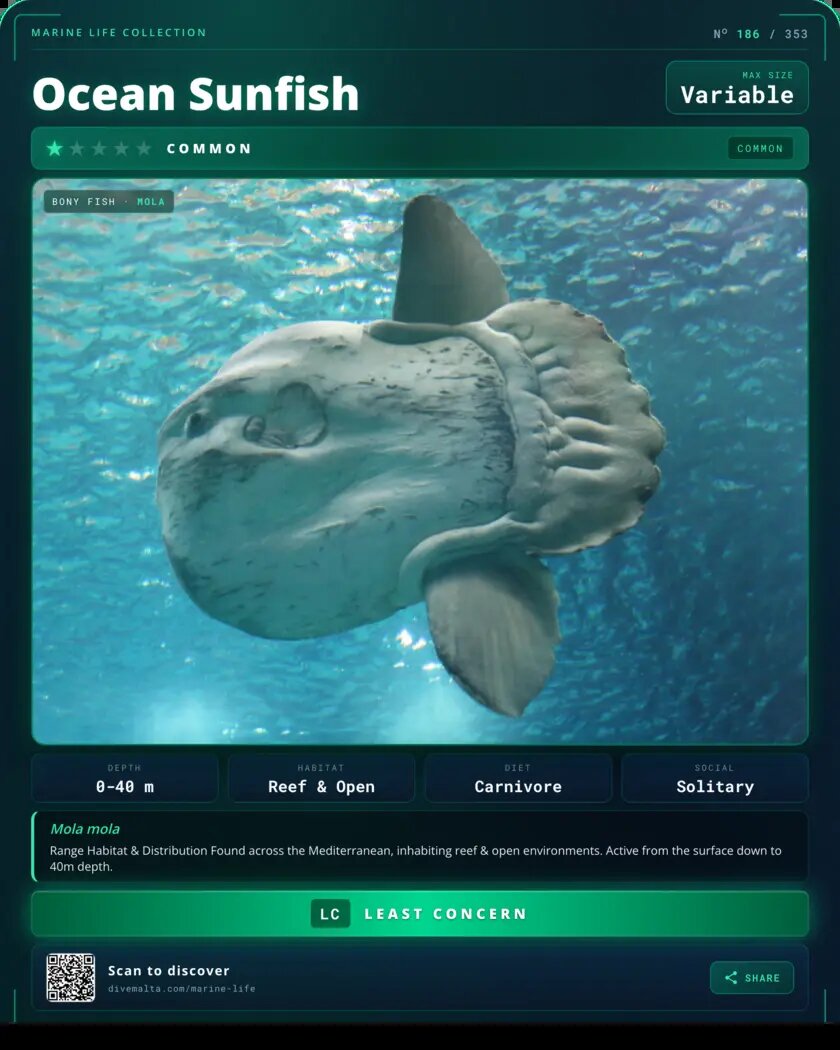
Ocean Sunfish species card

Behaviour & Diet

Feeding Strategy

Feeds primarily on jellyfish, salps and other gelatinous zooplankton, supplemented by small fish and crustaceans. Must consume large quantities due to the low nutritional value of its prey.

Gelativore

Reproduction

Produces more eggs than any other vertebrate, with a single female releasing up to 300 million eggs per spawning event. Eggs and larvae are tiny and pelagic.

Mass spawner

Behaviour & Defence

Enormous adult size deters most predators. Thick, rubbery skin up to 7 cm thick provides additional physical protection.

Size

Where to Encounter in Malta

The following dive sites offer strong habitat match for Mola mola. All are accessible on a guided dive with diveshack.

5-30m
North Malta

Cirkewwa

Rocky reef with caves, arches and ledges hosting a rich diversity of reef species.

View dive site ›
5-50m
Gozo

Blue Hole

One of the Med's most famous reef dive sites. Rocky walls and archways covered in life.

View dive site ›
18-36m
South Malta

Um El Faroud

The wreck lies on a sandy bottom surrounded by rocky reef -- a diverse habitat attracting reef species.

View dive site ›
IUCN Red List Least Concern

Conservation Status

This species is assessed as Least Concern on the IUCN Red List. Mediterranean populations face ongoing pressure from fishing activity, habitat degradation, and climate-driven changes to prey availability.

Source: iNaturalist Guide #888
by Lesley Clements (CC BY-SA)
diveshack Mediterranean Marine Life guide