Depth
Parablennius · Bony Fish

Mystery Blenny

Parablennius incognitus

0-15m
Depth Range
7cm
Max Size
Mediterranean
Distribution
0-15m
Depth Range
7cm
Max Size
Rocky reef
Habitat
Omnivore
Diet
Territorial
Social
LC
IUCN Status
Moderate
Sighting Likelihood
Kingdom Animalia
Phylum Chordata
Class Actinopterygii
Genus Parablennius
Species incognitus

Identification & Biology

  • IdentificationVery small blenny with a rounded head and short orbital tentacles. Olive-brown body with subtle darker markings. Almost identical to several other Parablennius species and requires expert examination to confirm.
  • SizeUp to 5 cm total length, typically around 3 cm.
  • Social HabitSolitary and territorial. Males guard small nest sites.
  • HabitatRocky reefs and boulder fields in shallow water.
  • Depth0 to 20 m, most common in the first 10 m.
  • Feeds OnAlgae and tiny invertebrates.
  • DistributionMediterranean Sea. An endemic species.
  • DescriptionTrue to its name, the mystery blenny is extremely difficult to distinguish from related species in the field. It was long confused with other Parablennius species and remains one of the more challenging small reef fish to identify without laboratory examination.

Habitat & Distribution

Found on shallow to moderate-depth rocky reefs throughout the Mediterranean. Common but easily confused with related species due to its cryptic appearance.

Where Malta divers have spotted this species

Loading…

Sightings are logged by divers using our What Did You See? dive-log tool. View the full live sightings map.

Detail

Preferred Environment

Inhabits rocky reefs with abundant small holes and crevices from the intertidal zone to around 15m depth. Typically perches near its shelter hole, ready to retreat.

Encounter Tips

Best approached slowly and calmly. Avoid casting shadows directly over the animal. Neutral buoyancy and patience increase encounter success significantly.
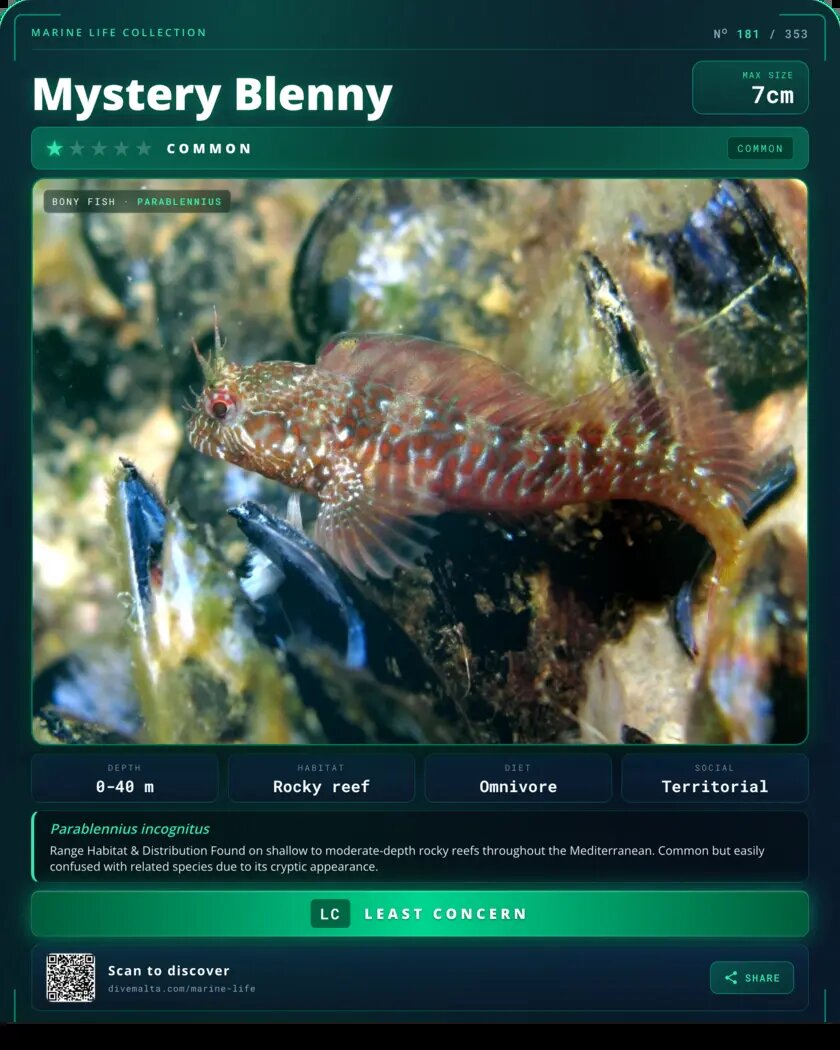
Mystery Blenny species card

Behaviour & Diet

Feeding Strategy

An omnivore that picks small invertebrates, worms, and algae from the surrounding rock surface. Forages within a small radius of its shelter.

Close-range forager

Reproduction

Males guard nest holes in rock crevices. Females lay eggs in the cavity, and the male provides parental care until the larvae hatch and disperse.

Cavity nester

Behaviour & Defence

Exceptionally well camouflaged against rocky substrates. Darts into its shelter hole when disturbed, often before a diver even notices it.

Cryptic & fast

Where to Encounter in Malta

Dive sites where Parablennius incognitus may be encountered will be added as sighting data is collected.

IUCN Red List Least Concern

Conservation Status

This species is assessed as Least Concern on the IUCN Red List. Mediterranean populations face ongoing pressure from fishing activity, habitat degradation, and climate-driven changes.

Source: IUCN Red List
diveshack Mediterranean Marine Life guide