Depth
Macroramphosus · Bony Fish

Longspine Snipefish

Macroramphosus scolopax

25-600m
Depth Range
18cm
Max Size
Mediterranean
Distribution
25-600m
Depth Range
18cm
Max Size
Deep water
Habitat
Planktivore
Diet
Schooling
Social
LC
IUCN Status
Low
Sighting Likelihood
KingdomAnimalia
PhylumChordata
ClassActinopterygii
GenusMacroramphosus
Speciesscolopax

Identification & Biology

  • IdentificationSmall, elongated body compressed laterally with a very long, tubular snout. Reddish-pink body with a long dorsal spine. Deeply forked tail. Armoured with bony plates along the body.
  • SizeUp to 20 cm total length, commonly 10 to 15 cm.
  • Social HabitSchooling species that forms small groups oriented head-down in the water column.
  • HabitatMidwater above rocky and mixed substrates. Often found near steep walls and drop-offs.
  • Depth25 to 600 m, most common between 50 and 200 m.
  • Feeds OnTiny planktonic crustaceans sucked in through the long tubular snout.
  • DistributionEastern Atlantic from the British Isles to South Africa, including the Mediterranean Sea.
  • DescriptionAn unusual fish that hovers head-down in small groups, using its elongated snout like a pipette to suck up tiny planktonic prey. Occasionally seen by divers on deeper dives near walls and drop-offs. Its pinkish colour and head-down posture make it one of the more distinctive finds on a deeper Mediterranean dive.

Habitat & Distribution

Typically found between 25 and 600 m depth, most common from 50 to 300 m. Inhabits mid-water and benthopelagic zones over the outer continental shelf and upper slope.

Where Malta divers have spotted this species

Loading…

Sightings are logged by divers using our What Did You See? dive-log tool. View the full live sightings map.

Detail

Preferred Environment

Prefers deep offshore waters with moderate currents. Often found in large schools hovering above muddy or sandy bottoms on the continental shelf edge.

Encounter Tips

Best approached slowly and calmly. Avoid casting shadows directly over the animal. Neutral buoyancy and patience increase encounter success significantly.
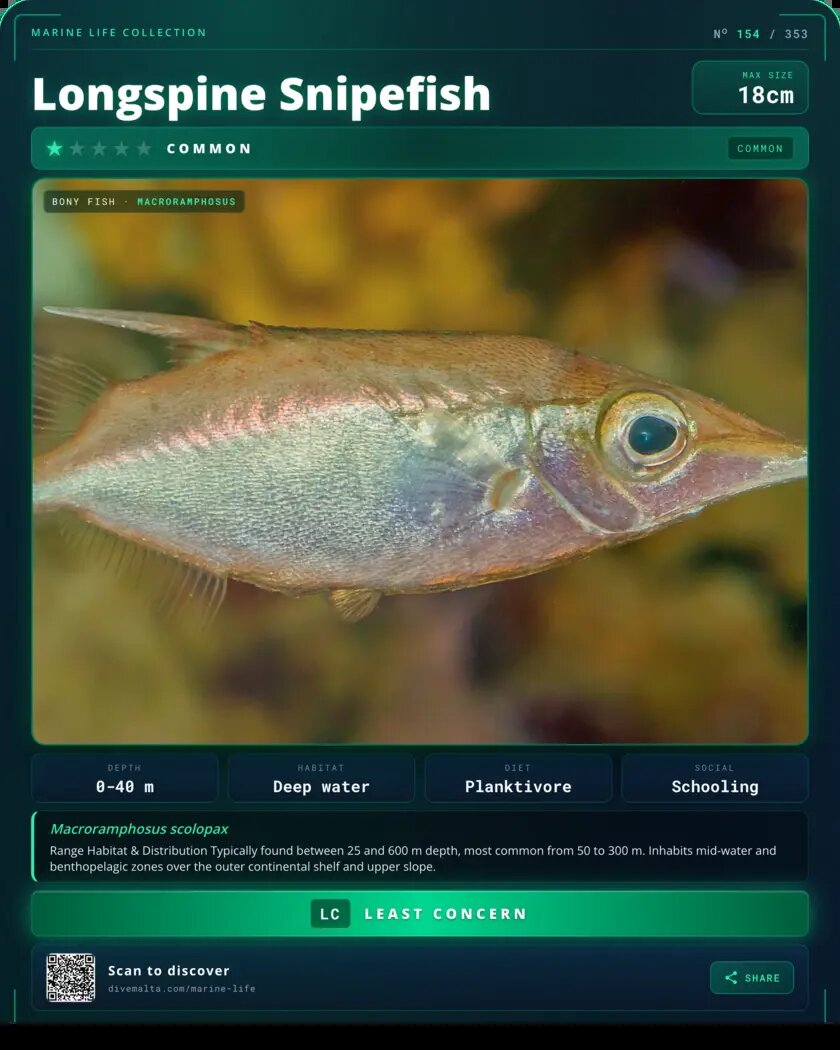
Longspine Snipefish species card

Behaviour & Diet

Feeding Strategy

Uses its long tubular snout to pick tiny planktonic crustaceans from the water column. Feeds on copepods, mysids, and other small zooplankton.

Precision plankton picker

Reproduction

Spawns in open water, releasing pelagic eggs. Juveniles undergo a body shape transformation as they develop the characteristic elongated snout.

Pelagic spawner

Behaviour & Defence

The elongated dorsal spine acts as a deterrent to predators. Schools also use coordinated movement to confuse attackers.

Spine defence

Where to Encounter in Malta

Dive sites where Macroramphosus scolopax may be encountered will be added as sighting data is collected.

IUCN Red List Least Concern

Conservation Status

This species is assessed as Least Concern on the IUCN Red List. Mediterranean populations face ongoing pressure from fishing activity, habitat degradation, and climate-driven changes.

Source: IUCN Red List
diveshack Mediterranean Marine Life guide