Depth
Caretta · Bony Fish

Loggerhead Sea Turtle

Caretta caretta

0-200m
Depth Range
120cm
Max Size
Mediterranean
Distribution
0-200m
Depth Range
120cm
Max Size
Coastal pelagic
Habitat
Omnivore
Diet
Solitary
Social
VU
IUCN Status
Rare
Sighting Likelihood
Kingdom Animalia
Phylum Chordata
Class Reptilia
Genus Caretta
Species caretta

Identification & Biology

  • IdentificationLarge marine turtle with a reddish-brown carapace (shell) and yellowish-brown plastron (underside). Heart-shaped carapace. Very large head relative to body size with powerful jaws. Front flippers are short and broad.
  • SizeCarapace length up to 120 cm. Weight up to 200 kg, commonly 80 to 150 kg.
  • Social HabitSolitary except during mating. Females nest on sandy beaches, returning to the same beach where they hatched.
  • HabitatOpen ocean, coastal waters, bays, and harbours. Nests on sandy beaches. Found in a variety of marine habitats throughout its life.
  • DepthSurface to 200 m for foraging dives, predominantly near the surface.
  • Feeds OnJellyfish, crabs, sea urchins, fish, and sponges crushed with its powerful jaws.
  • DistributionWorldwide in tropical and temperate seas. The Mediterranean hosts one of the most important breeding populations.
  • DescriptionThe most common sea turtle in the Mediterranean and a magical encounter for divers. Loggerhead turtles are frequently seen on Maltese dives, especially near wrecks and reefs where they rest and forage. The Mediterranean population nests primarily on Greek, Turkish, and Libyan beaches. Threatened by plastic ingestion, boat strikes, and incidental capture in fishing gear.

Habitat & Distribution

Ranges from shallow coastal bays to open ocean waters down to about 200 metres, though most foraging occurs in shallower zones. The Mediterranean hosts a distinct breeding population, with nesting beaches primarily in Greece, Turkey, Libya and Cyprus.

Where Malta divers have spotted this species

Loading…

Sightings are logged by divers using our What Did You See? dive-log tool. View the full live sightings map.

Detail

Preferred Environment

Frequents warm coastal waters with rocky and sandy substrates where benthic prey is abundant. Around Malta, turtles are regularly spotted on dive sites, resting on reef ledges or foraging among Posidonia seagrass meadows.

Encounter Tips

Best approached slowly and calmly. Avoid casting shadows directly over the animal. Neutral buoyancy and patience increase encounter success significantly.
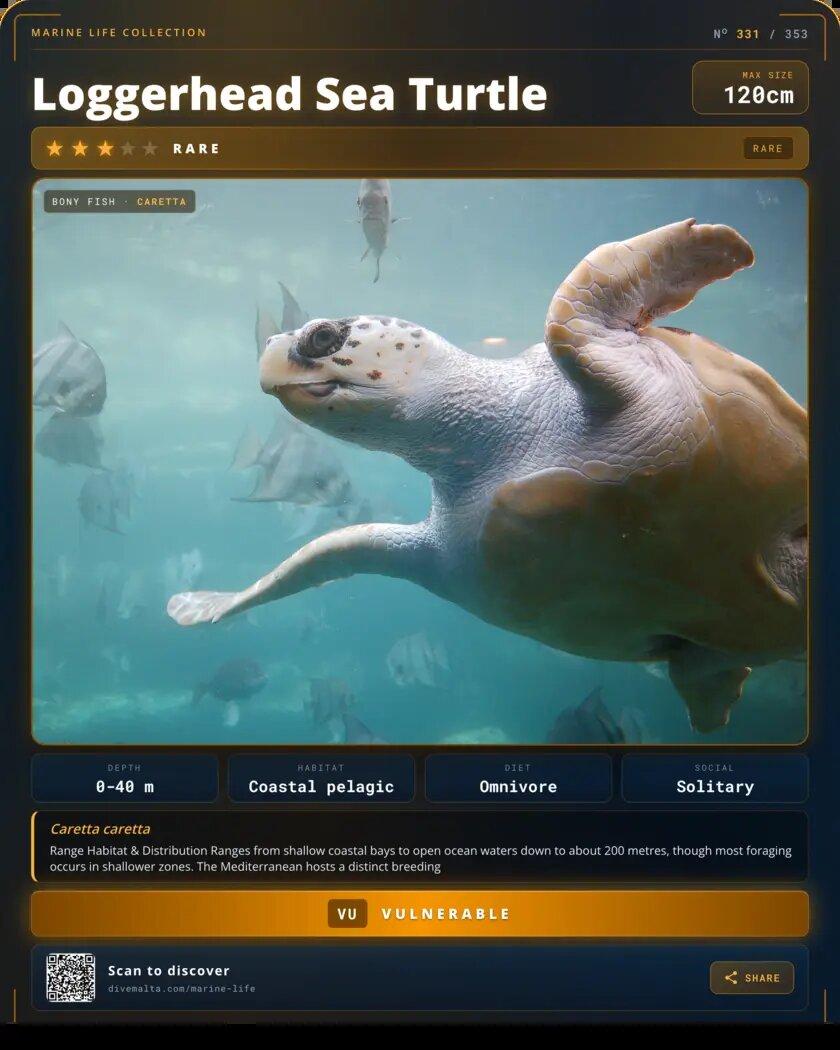
Loggerhead Sea Turtle species card

Behaviour & Diet

Feeding Strategy

A powerful-jawed omnivore that feeds on crabs, sea urchins, jellyfish, sponges, molluscs and occasionally seagrass. The oversized head houses strong jaw muscles capable of crushing hard-shelled prey.

Shell Crusher

Reproduction

Females return to nesting beaches every two to three years, laying multiple clutches of around 100 eggs each. Hatchlings emerge at night and orient towards the sea using moonlight reflected on the water surface.

Beach Nester

Behaviour & Defence

Its large, hard carapace provides excellent protection from most predators. Adults have few natural enemies in the Mediterranean, though boat strikes and fishing gear entanglement remain serious threats.

Armoured Shell

Where to Encounter in Malta

Dive sites where Caretta caretta may be encountered will be added as sighting data is collected.

IUCN Red List Vulnerable

Conservation Status

This species is assessed as Vulnerable on the IUCN Red List. Mediterranean populations face ongoing pressure from fishing activity, habitat degradation, and climate-driven changes.

Source: IUCN Red List
diveshack Mediterranean Marine Life guide