Depth
Schedophilus · Bony Fish

Imperial Blackfish

Schedophilus ovalis

0-600m
Depth Range
100cm
Max Size
Mediterranean
Distribution
0-600m
Depth Range
100cm
Max Size
Pelagic / Deep
Habitat
Omnivore
Diet
Solitary
Social
LC
IUCN Status
Low
Sighting Likelihood
KingdomAnimalia
PhylumChordata
ClassActinopterygii
GenusSchedophilus
Speciesovalis

Identification & Biology

  • IdentificationDeep, oval body strongly compressed from the sides. Dark grey to brown body that appears almost black in deep water. Prominent rounded forehead and small mouth. Single long dorsal fin.
  • SizeUp to 100 cm total length, commonly 40 to 60 cm.
  • Social HabitUsually solitary or in very small groups. A midwater species of the open ocean.
  • HabitatOpen water, mesopelagic. Occasionally found near the surface sheltering under floating objects.
  • Depth100 to 600 m, occasionally near the surface.
  • Feeds OnJellyfish, salps, comb jellies, and other gelatinous organisms.
  • DistributionWorldwide in tropical and temperate seas, including the Mediterranean Sea.
  • DescriptionA mysterious open-ocean fish that feeds primarily on jellyfish and other gelatinous creatures. Juveniles shelter beneath floating objects and jellyfish, while adults live in deep midwater. Rarely encountered by divers, though juveniles occasionally appear near the surface under debris.

Habitat & Distribution

Ranges from the surface to 600 m depth. Juveniles are pelagic and commonly associated with drifting jellyfish, while adults move to deeper benthopelagic habitats.

Where Malta divers have spotted this species

Loading…

Sightings are logged by divers using our What Did You See? dive-log tool. View the full live sightings map.

Detail

Preferred Environment

Juveniles favour open surface waters where large jellyfish provide shelter. Adults prefer deep water over the continental slope and around seamounts.

Encounter Tips

Best approached slowly and calmly. Avoid casting shadows directly over the animal. Neutral buoyancy and patience increase encounter success significantly.
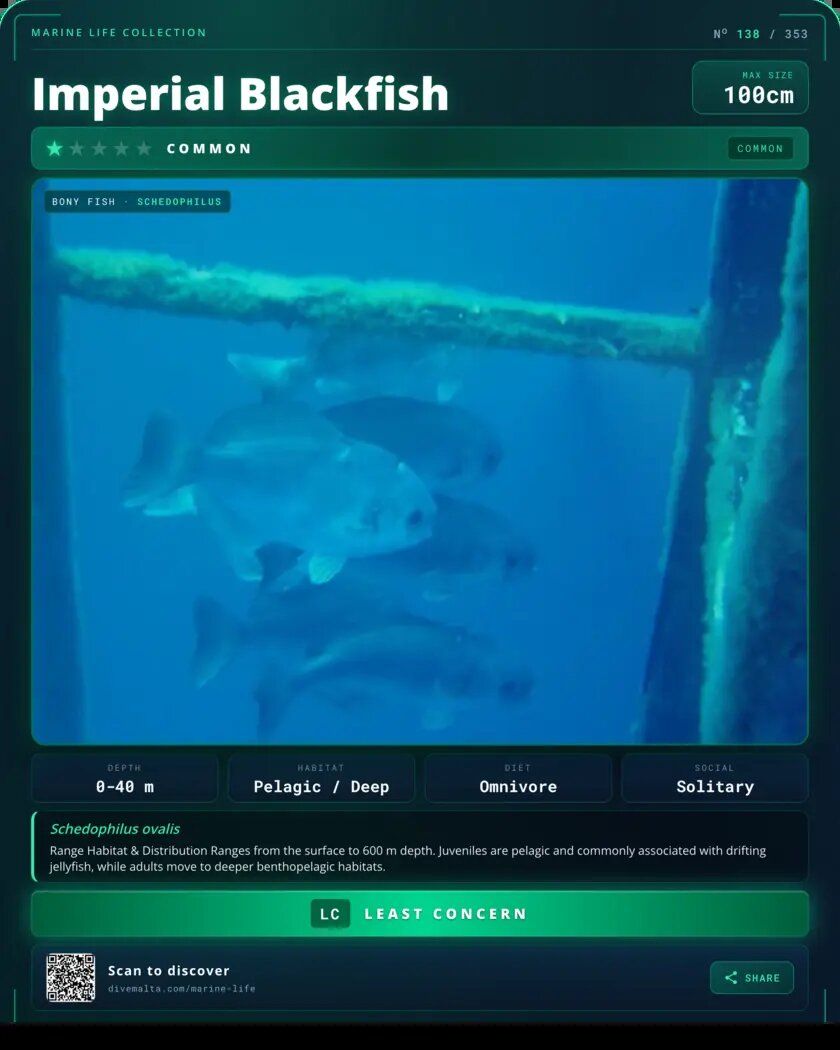
Imperial Blackfish species card

Behaviour & Diet

Feeding Strategy

Feeds on jellyfish, salps, small fish, and crustaceans. Juveniles specialise in consuming jellyfish tentacles, gradually shifting to a broader diet as they mature.

Jellyfish specialist

Reproduction

Spawning biology is not fully understood. Eggs are believed to be pelagic, with larvae developing in surface waters before associating with jellyfish hosts.

Pelagic eggs

Behaviour & Defence

Juveniles gain protection by sheltering among the stinging tentacles of jellyfish, to which they develop immunity. Adults rely on their size and deep habitat.

Jellyfish symbiosis

Where to Encounter in Malta

Dive sites where Schedophilus ovalis may be encountered will be added as sighting data is collected.

IUCN Red ListLeast Concern

Conservation Status

This species is assessed as Least Concern on the IUCN Red List. Mediterranean populations face ongoing pressure from fishing activity, habitat degradation, and climate-driven changes.

Source: IUCN Red List
diveshack Mediterranean Marine Life guide