Labrus viridis
Bony Fish
Range
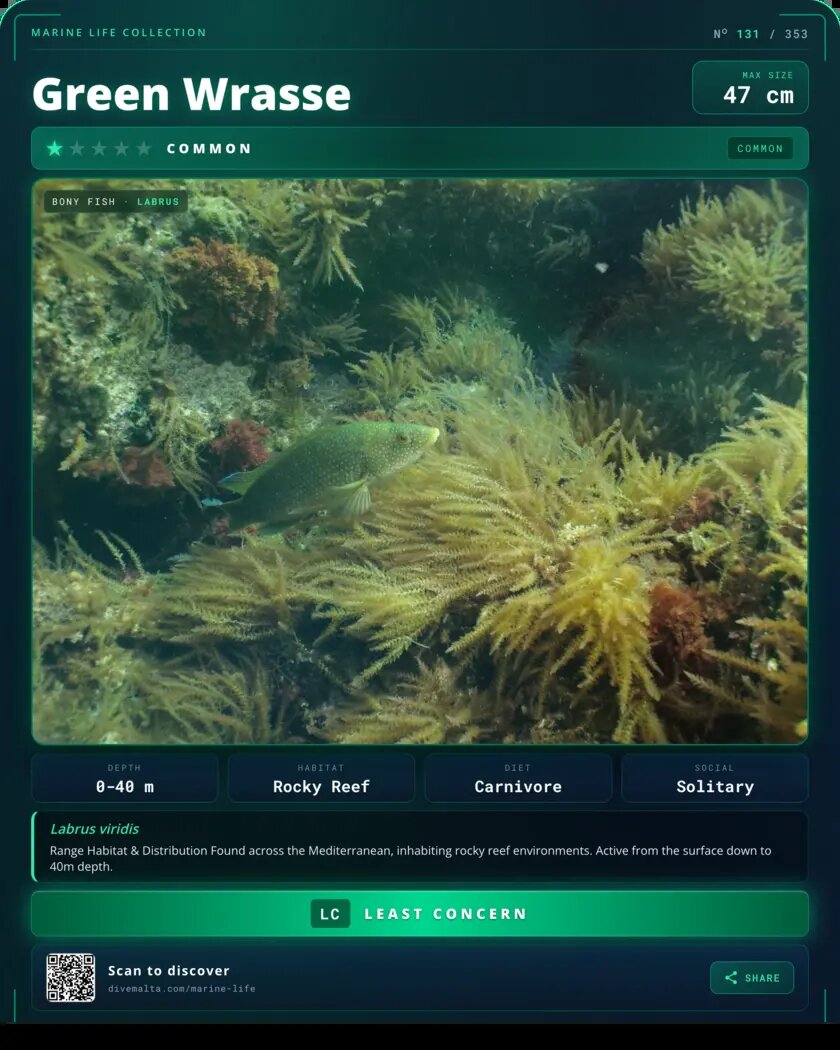
Found across the Mediterranean, inhabiting rocky reef environments. Active from the surface down to 40m depth.
Sightings are logged by divers using our What Did You See? dive-log tool. View the full live sightings map.
Rocky Reef habitats, typically at depths of 0-40m. Most commonly encountered by divers at the shallower end of its range.
Swim along the edges and clearings within Posidonia meadows. Males are conspicuous due to their bright green colour and large size. Females are harder to spot among the brown-green seagrass blades.
Biology
Feeds on sea urchins, crustaceans, molluscs and worms. Uses its strong pharyngeal teeth to crush hard-shelled invertebrates.
Shell crusherA protogynous hermaphrodite. Males build algae nests on rocky substrates and defend them while courting passing females.
Nest builderBuries itself in sand at night and may secrete a protective mucus cocoon while sleeping. During the day, relies on swift swimming to escape threats.
Sand burialDive with diveshack
The following dive sites offer strong habitat match for Labrus viridis. All are accessible on a guided dive with diveshack.
Rocky reef with caves, arches and ledges hosting a rich diversity of reef species.
View dive site ›One of the Med's most famous reef dive sites. Rocky walls and archways covered in life.
View dive site ›The wreck lies on a sandy bottom surrounded by rocky reef -- a diverse habitat attracting reef species.
View dive site ›This species is assessed as Least Concern on the IUCN Red List. Mediterranean populations face ongoing pressure from fishing activity, habitat degradation, and climate-driven changes to prey availability.