Depth
Sardina · Bony Fish

European Pilchard

Sardina pilchardus

0-150m
Depth Range
27cm
Max Size
Mediterranean
Distribution
0-150m
Depth Range
27cm
Max Size
Pelagic
Habitat
Planktivore
Diet
Schooling
Social
LC
IUCN Status
Moderate
Sighting Likelihood
Kingdom Animalia
Phylum Chordata
Class Actinopterygii
Genus Sardina
Species pilchardus

Identification & Biology

  • IdentificationSmall, streamlined fish with a rounded belly. Blue-green back with silver flanks and a row of dark spots along the upper flank behind the gill cover. Single dorsal fin. Scales are deciduous and fall off easily when handled.
  • SizeUp to 27 cm total length, commonly 15 to 20 cm.
  • Social HabitExtremely gregarious, forming enormous schools near the surface that can stretch for kilometres.
  • HabitatPelagic in coastal and offshore waters. Found near the surface, often in areas of high plankton productivity.
  • DepthSurface to 150 m, most common in the upper 50 m.
  • Feeds OnPhytoplankton and zooplankton filtered from the water using gill rakers.
  • DistributionEastern Atlantic from the North Sea to Senegal, including the entire Mediterranean and Black Sea.
  • DescriptionThe Mediterranean sardine and one of the most commercially important fish in the region. Pilchard schools form the base of the marine food web, supporting populations of tuna, dolphins, seabirds, and many other predators. Their enormous numbers make them one of the most ecologically significant species in Mediterranean waters.

Habitat & Distribution

Abundant in coastal and open pelagic waters throughout the Mediterranean and eastern Atlantic. Found from the surface to around 150m, often forming vast schools in nutrient-rich upwelling zones.

Where Malta divers have spotted this species

Loading…

Sightings are logged by divers using our What Did You See? dive-log tool. View the full live sightings map.

Detail

Preferred Environment

Thrives in temperate coastal waters with good plankton availability. Commonly encountered near the surface in bays and open sea, often over sandy or muddy bottoms.

Encounter Tips

Best approached slowly and calmly. Avoid casting shadows directly over the animal. Neutral buoyancy and patience increase encounter success significantly.
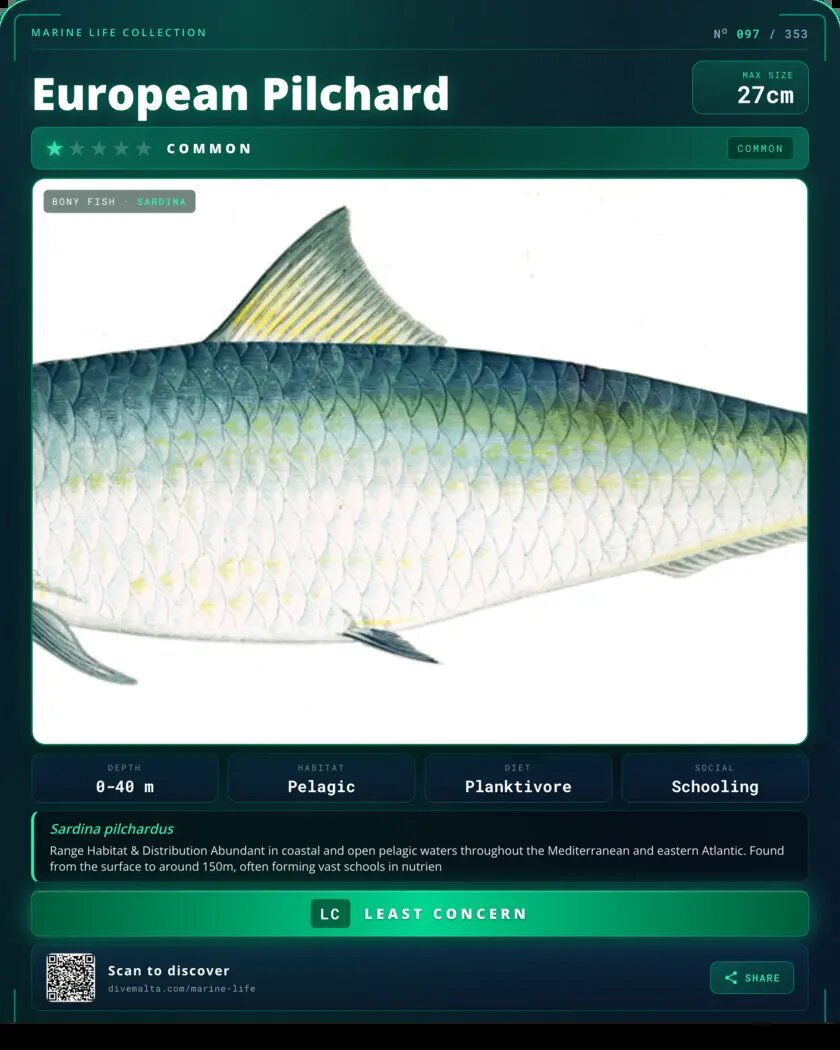
European Pilchard species card

Behaviour & Diet

Feeding Strategy

A filter feeder that swims with its mouth open to strain phytoplankton, zooplankton, and small crustaceans from the water column.

Filter feeder

Reproduction

Spawns multiple times per year, releasing buoyant eggs into open water. Peak spawning in the Mediterranean occurs during winter and early spring.

Pelagic spawner

Behaviour & Defence

Forms dense, fast-moving schools that create a confusing visual display for predators. Individuals have reflective scales that scatter light underwater.

Schooling defence

Where to Encounter in Malta

Dive sites where Sardina pilchardus may be encountered will be added as sighting data is collected.

IUCN Red List Least Concern

Conservation Status

This species is assessed as Least Concern on the IUCN Red List. Mediterranean populations face ongoing pressure from fishing activity, habitat degradation, and climate-driven changes.

Source: IUCN Red List
diveshack Mediterranean Marine Life guide