Depth
Siganus · Bony Fish

Dusky Spinefoot

Siganus luridus

0-20m
Depth Range
25cm
Max Size
Mediterranean
Distribution
0-20m
Depth Range
25cm
Max Size
Rocky shore
Habitat
Herbivore
Diet
Schooling
Social
LC
IUCN Status
Moderate
Sighting Likelihood
Kingdom Animalia
Phylum Chordata
Class Actinopterygii
Genus Siganus
Species luridus

Identification & Biology

  • IdentificationOval, laterally compressed body with venomous spines in the dorsal, anal, and pelvic fins. Dark olive-brown to grey body, sometimes with faint mottling. Small, rabbit-like mouth.
  • SizeUp to 25 cm total length, commonly 12 to 18 cm.
  • Social HabitFound in small schools or loose groups browsing on algae-covered surfaces.
  • HabitatRocky reefs and harbour structures with abundant algal growth. A Lessepsian migrant from the Red Sea.
  • Depth1 to 40 m, most common between 2 and 15 m.
  • Feeds OnAlgae grazed from rock surfaces. A dedicated herbivore that can significantly alter algal communities where it becomes abundant.
  • DistributionOriginally Red Sea and Indian Ocean. Now established across the eastern and central Mediterranean following Lessepsian migration.
  • DescriptionA Lessepsian migrant that has become one of the most ecologically impactful invasive species in the eastern Mediterranean. Schools of dusky spinefoot can graze rocky reefs bare of algae, fundamentally changing the reef ecosystem. Its venomous fin spines can deliver a painful sting. Now common in Maltese waters.

Habitat & Distribution

Inhabits shallow rocky coasts and mixed rocky-sandy habitats from the surface to about 20 metres depth. Since entering the Mediterranean via the Suez Canal, it has spread rapidly through the eastern basin, overgrazing native algae communities.

Where Malta divers have spotted this species

Loading…

Sightings are logged by divers using our What Did You See? dive-log tool. View the full live sightings map.

Detail

Preferred Environment

Prefers warm, shallow rocky substrates with algal growth, including harbour walls, rocky flats and artificial structures. Grazes intensively on native algae, often creating conspicuous barren patches on the rock.

Encounter Tips

Best approached slowly and calmly. Avoid casting shadows directly over the animal. Neutral buoyancy and patience increase encounter success significantly.
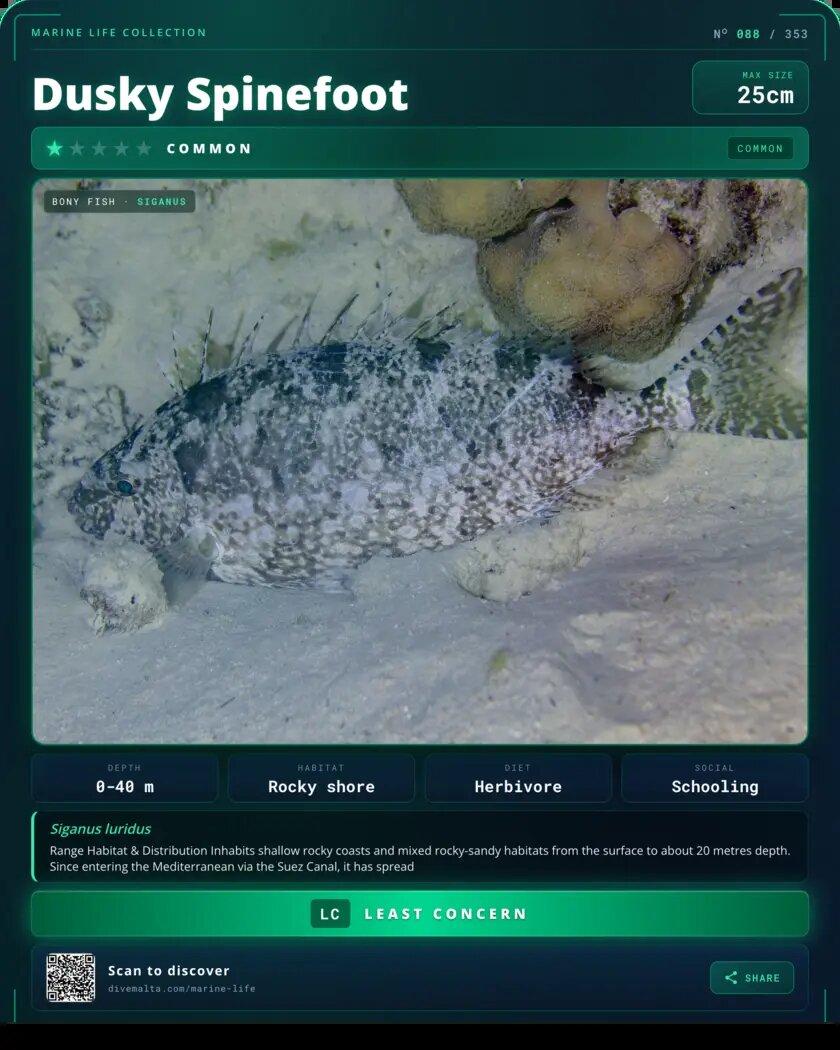
Dusky Spinefoot species card

Behaviour & Diet

Feeding Strategy

A voracious herbivore that grazes on a wide variety of algae and seagrass. Its intensive feeding has significantly reduced algal cover in parts of the eastern Mediterranean, altering entire ecosystems.

Destructive Grazer

Reproduction

Spawns in shallow coastal waters during the warm season. High reproductive output and tolerance of varied conditions have contributed to its rapid invasive spread.

Prolific Breeder

Behaviour & Defence

Possesses sharp, venomous spines in its dorsal, anal and pelvic fins that can deliver a painful sting. When threatened, it raises these spines as an effective deterrent.

Venomous Spines

Where to Encounter in Malta

Dive sites where Siganus luridus may be encountered will be added as sighting data is collected.

IUCN Red List Least Concern

Conservation Status

This species is assessed as Least Concern on the IUCN Red List. Mediterranean populations face ongoing pressure from fishing activity, habitat degradation, and climate-driven changes.

Source: IUCN Red List
diveshack Mediterranean Marine Life guide