Depth
Epinephelus · Bony Fish

Dogtooth Grouper

Epinephelus caninus

0-40m
Depth Range
Variable
Max Size
Mediterranean
Distribution
0-40m
Depth Range
Variable
Max Size
Reef & Open
Habitat
Carnivore
Diet
Solitary
Social
LC
IUCN Status
Low
Sighting Likelihood
Kingdom Animalia
Phylum Chordata
Class Actinopterygii
Genus Epinephelus
Species caninus

Identification & Biology

  • IdentificationLarge, robust grouper with a wide head and powerful jaws. Grey-brown body with scattered small dark spots. Distinctive canine teeth visible when the mouth is open. Rounded tail.
  • SizeUp to 120 cm total length and 15 kg, commonly 40 to 80 cm.
  • Social HabitSolitary and territorial. Occupies caves and deep crevices on rocky reefs.
  • HabitatDeep rocky reefs, boulder fields, and steep drop-offs. Prefers areas with large caves and overhangs.
  • Depth20 to 300 m, most common between 50 and 200 m.
  • Feeds OnFish, crustaceans, and cephalopods caught near the seabed.
  • DistributionEastern Atlantic from Portugal to Angola, including the Mediterranean Sea.
  • DescriptionA large, deep-dwelling grouper that is rarely encountered on recreational dives due to its preference for depths beyond 50 m. Named for its prominent canine teeth, it is a powerful predator of deep rocky reefs. Numbers have declined due to fishing pressure, and it is now uncommon throughout much of its range.

Habitat & Distribution

Found across the Mediterranean, inhabiting reef & open environments. Active from the surface down to 40m depth.

Where Malta divers have spotted this species

Loading…

Sightings are logged by divers using our What Did You See? dive-log tool. View the full live sightings map.

Detail

Preferred Environment

Reef & Open habitats, typically at depths of 0-40m. Most commonly encountered by divers at the shallower end of its range.

Encounter Tips

Best approached slowly and calmly. Avoid casting shadows directly over the animal. Neutral buoyancy and patience increase encounter success significantly.
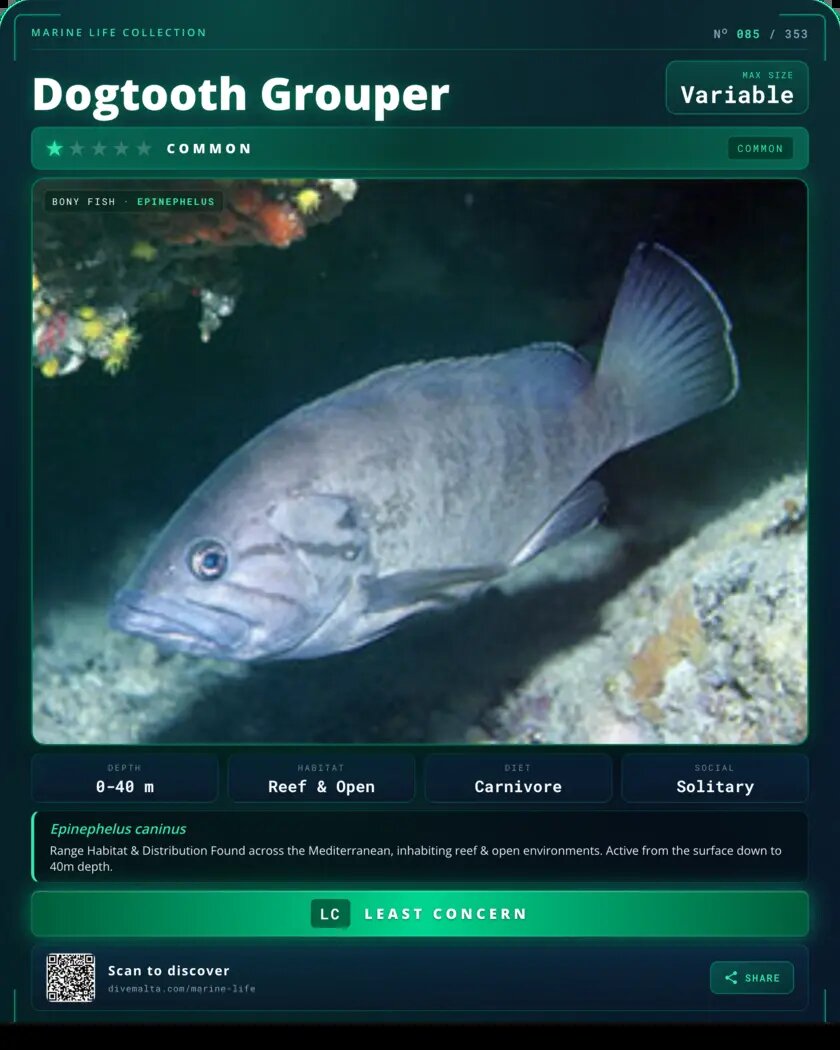
Dogtooth Grouper species card

Behaviour & Diet

Feeding Strategy

Hunts fish and cephalopods using ambush tactics from rocky lairs. Its large canine teeth are adapted for gripping fast-moving prey.

Ambush predator

Reproduction

A protogynous hermaphrodite, starting life as female and becoming male. Spawns during summer at specific aggregation sites.

Hermaphrodite

Behaviour & Defence

Retreats into caves and deep rocky crevices when threatened. Its robust build and powerful jaws discourage most predators.

Cave dweller

Where to Encounter in Malta

The following dive sites offer strong habitat match for Epinephelus caninus. All are accessible on a guided dive with diveshack.

5-30m
North Malta

Cirkewwa

Rocky reef with caves, arches and ledges hosting a rich diversity of reef species.

View dive site ›
5-50m
Gozo

Blue Hole

One of the Med's most famous reef dive sites. Rocky walls and archways covered in life.

View dive site ›
18-36m
South Malta

Um El Faroud

The wreck lies on a sandy bottom surrounded by rocky reef -- a diverse habitat attracting reef species.

View dive site ›
IUCN Red List Least Concern

Conservation Status

This species is assessed as Least Concern on the IUCN Red List. Mediterranean populations face ongoing pressure from fishing activity, habitat degradation, and climate-driven changes to prey availability.

Source: iNaturalist Guide #888
by Lesley Clements (CC BY-SA)
diveshack Mediterranean Marine Life guide