Depth
Trachurus · Bony Fish

Blue Jack Mackerel

Trachurus picturatus

0-370m
Depth Range
60cm
Max Size
Mediterranean
Distribution
0-370m
Depth Range
60cm
Max Size
Pelagic
Habitat
Carnivore
Diet
Schooling
Social
LC
IUCN Status
Moderate
Sighting Likelihood
KingdomAnimalia
PhylumChordata
ClassActinopterygii
GenusTrachurus
Speciespicturatus

Identification & Biology

  • IdentificationElongated, fusiform body with a blue-green back and silver flanks. Very large eyes. A line of enlarged scutes runs along the rear portion of the lateral line. Second dorsal fin is long.
  • SizeUp to 60 cm total length, commonly 25 to 40 cm.
  • Social HabitSchooling species that forms large aggregations in midwater, often near seamounts and offshore structures.
  • HabitatPelagic in oceanic and coastal waters. Often found over deep water near the continental shelf edge.
  • DepthSurface to 370 m, most common between 50 and 200 m.
  • Feeds OnSmall fish, crustaceans, and squid caught in midwater.
  • DistributionEastern Atlantic from Norway to South Africa, including the Mediterranean Sea.
  • DescriptionA deeper-water relative of the common horse mackerel, distinguished by its exceptionally large eyes. Blue jack mackerel form large schools over seamounts and deep reefs. They are an important link in the pelagic food web, feeding on small prey and in turn providing food for tuna and other large predators.

Habitat & Distribution

Ranges from the surface to around 370 m depth, though most common in the upper 200 m. Found in oceanic and coastal pelagic environments throughout the Mediterranean.

Where Malta divers have spotted this species

Loading…

Sightings are logged by divers using our What Did You See? dive-log tool. View the full live sightings map.

Detail

Preferred Environment

Prefers deeper offshore waters compared to other horse mackerels. Often found over seamounts, banks, and areas with strong oceanic influence.

Encounter Tips

Best approached slowly and calmly. Avoid casting shadows directly over the animal. Neutral buoyancy and patience increase encounter success significantly.
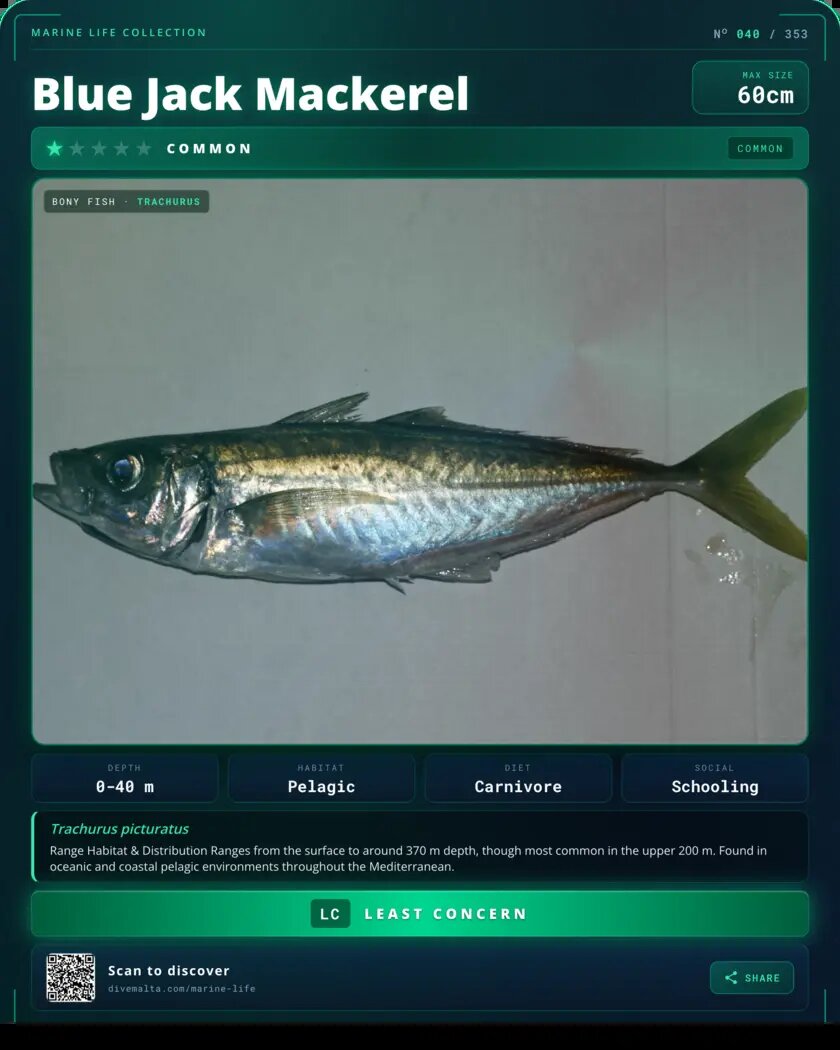
Blue Jack Mackerel species card

Behaviour & Diet

Feeding Strategy

Feeds mainly on small crustaceans, fish larvae, and zooplankton. Forages actively in mid-water, following vertical migrations of plankton.

Plankton & fish feeder

Reproduction

Spawns in open water from late winter to spring. Pelagic eggs hatch rapidly, and juveniles form schools in the upper water column.

Pelagic spawner

Behaviour & Defence

Uses speed and dense schooling to avoid predation. Schools can number in the thousands, creating a shimmering wall effect that confuses predators.

Mass schooling

Where to Encounter in Malta

Dive sites where Trachurus picturatus may be encountered will be added as sighting data is collected.

IUCN Red List Least Concern

Conservation Status

This species is assessed as Least Concern on the IUCN Red List. Mediterranean populations face ongoing pressure from fishing activity, habitat degradation, and climate-driven changes.

Source: IUCN Red List
diveshack Mediterranean Marine Life guide