Depth
Atherina · Bony Fish

Big-scale Sand Smelt

Atherina boyeri

0-20m
Depth Range
15cm
Max Size
Mediterranean
Distribution
0-20m
Depth Range
15cm
Max Size
Coastal
Habitat
Planktivore
Diet
Schooling
Social
LC
IUCN Status
Moderate
Sighting Likelihood
Kingdom Animalia
Phylum Chordata
Class Actinopterygii
Genus Atherina
Species boyeri

Identification & Biology

  • IdentificationSmall, slender, elongated fish with a slightly compressed body. Silver body with a bright silver lateral band. Large scales for its size. Two well-separated dorsal fins.
  • SizeUp to 20 cm total length, commonly 10 to 15 cm.
  • Social HabitHighly gregarious, forming dense schools in shallow water, estuaries, and lagoons.
  • HabitatShallow coastal waters, lagoons, harbours, and estuaries. Tolerates a wide range of salinities from fresh to fully marine water.
  • DepthSurface to 10 m, predominantly in the first 3 m.
  • Feeds OnZooplankton, small crustaceans, and insect larvae caught near the surface.
  • DistributionEastern Atlantic from the British Isles to Senegal, including the entire Mediterranean and Black Sea.
  • DescriptionOne of the most abundant small fish in Mediterranean coastal lagoons and harbours. Schools of sand smelts shimmer just below the surface, attracting predators from herons to sea bass. Their tolerance for brackish and even fresh water makes them one of the most adaptable coastal species.

Habitat & Distribution

Extremely common in shallow coastal waters, harbours, lagoons, and brackish environments throughout the Mediterranean. Tolerant of a wide range of salinities from fresh to fully marine water.

Where Malta divers have spotted this species

Loading…

Sightings are logged by divers using our What Did You See? dive-log tool. View the full live sightings map.

Detail

Preferred Environment

Found in calm, sheltered coastal areas including harbours, marinas, and shallow sandy bays. Forms dense schools near the surface, often visible from shore.

Encounter Tips

Best approached slowly and calmly. Avoid casting shadows directly over the animal. Neutral buoyancy and patience increase encounter success significantly.
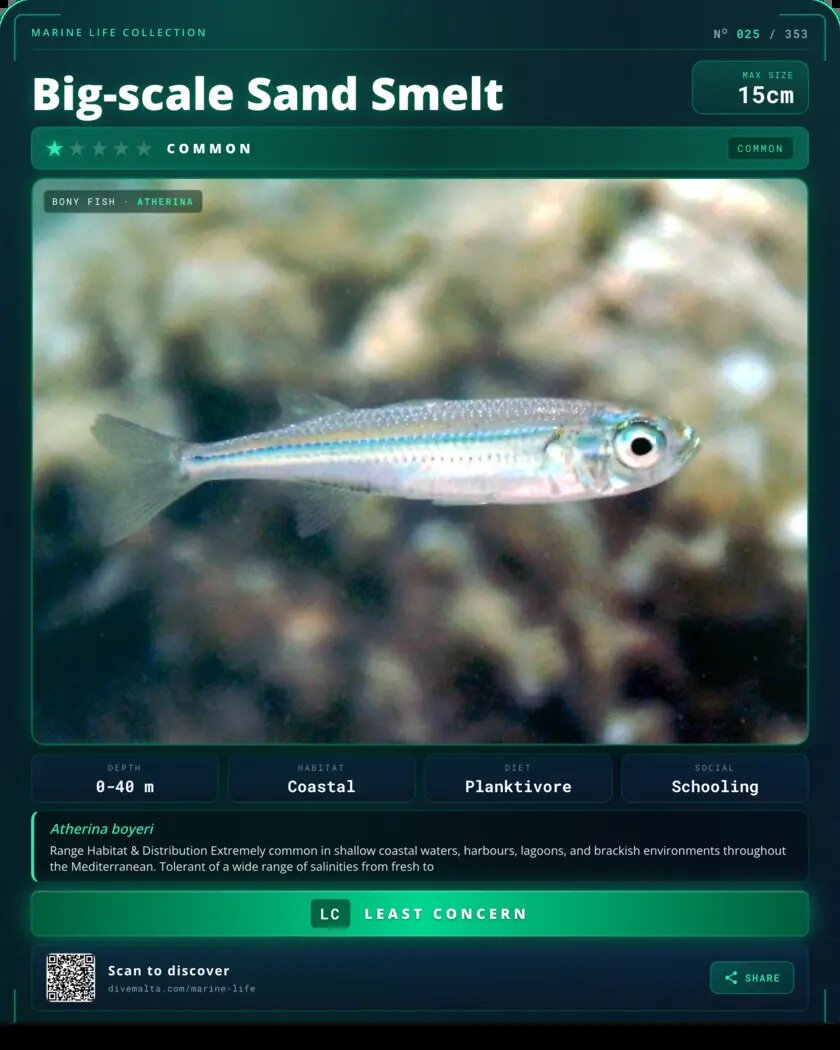
Big-scale Sand Smelt species card

Behaviour & Diet

Feeding Strategy

Feeds on zooplankton, tiny crustaceans, and insect larvae near the water surface. Actively picks individual prey items from the water column.

Selective planktivore

Reproduction

Spawns in shallow water from spring through summer. Eggs have adhesive filaments that anchor them to seagrass or algae.

Shallow spawner

Behaviour & Defence

Dense schooling behaviour is the primary defence. The translucent body and reflective stripe provide camouflage in sunlit surface waters.

Schooling camouflage

Where to Encounter in Malta

Dive sites where Atherina boyeri may be encountered will be added as sighting data is collected.

IUCN Red List Least Concern

Conservation Status

This species is assessed as Least Concern on the IUCN Red List. Mediterranean populations face ongoing pressure from fishing activity, habitat degradation, and climate-driven changes.

Source: IUCN Red List
diveshack Mediterranean Marine Life guide