Depth
Ariosoma · Bony Fish

Bandtooth Conger

Ariosoma balearicum

10-730m
Depth Range
50cm
Max Size
Mediterranean
Distribution
10-730m
Depth Range
50cm
Max Size
Sandy seabed
Habitat
Carnivore
Diet
Solitary
Social
LC
IUCN Status
Moderate
Sighting Likelihood
Kingdom Animalia
Phylum Chordata
Class Actinopterygii
Genus Ariosoma
Species balearicum

Identification & Biology

  • IdentificationElongated eel with a cylindrical body tapering to a pointed tail. Pale grey to yellowish with no prominent markings. Small head with a short, rounded snout and small eyes.
  • SizeUp to 60 cm total length, commonly 30 to 40 cm.
  • Social HabitSolitary and burrowing. Lives within soft substrates and is rarely seen in the open.
  • HabitatSandy and muddy bottoms on the continental shelf. Burrows into soft sediment during the day.
  • Depth10 to 700 m, most common between 30 and 200 m.
  • Feeds OnSmall invertebrates including crustaceans and worms found in the sediment.
  • DistributionEastern Atlantic and Mediterranean Sea, from the Bay of Biscay to West Africa.
  • DescriptionA small, inconspicuous conger eel that spends most of its life buried in sandy or muddy substrates. Unlike the common conger eel, it is slender and pale-coloured with a preference for soft bottoms. Very rarely encountered by divers.

Habitat & Distribution

Found on sandy and muddy bottoms from about 10 to over 700 metres depth, where it burrows tail-first into the sediment. In the Mediterranean, it is widespread but rarely seen due to its burrowing habit and nocturnal behaviour.

Where Malta divers have spotted this species

Loading…

Sightings are logged by divers using our What Did You See? dive-log tool. View the full live sightings map.

Detail

Preferred Environment

Prefers soft sediment habitats -- fine sand and mud -- where it can excavate burrows. Typically found on open sandy plains and the sandy margins of seagrass meadows and rocky reefs.

Encounter Tips

Best approached slowly and calmly. Avoid casting shadows directly over the animal. Neutral buoyancy and patience increase encounter success significantly.
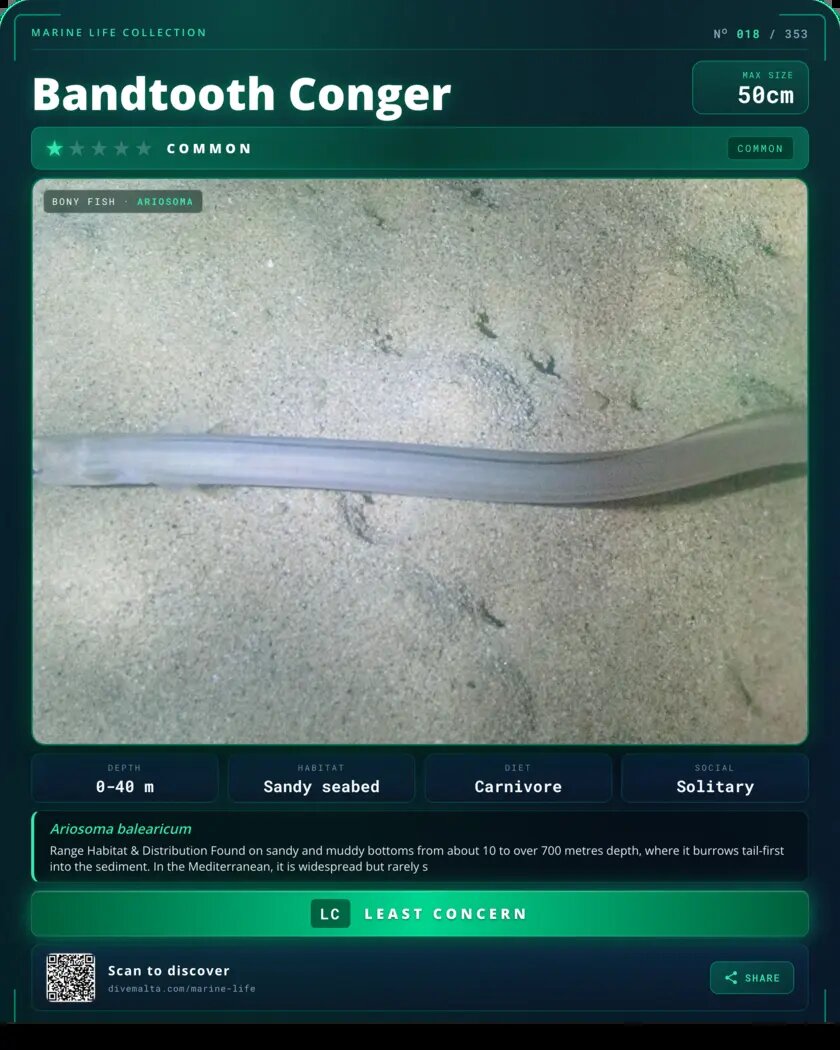
Bandtooth Conger species card

Behaviour & Diet

Feeding Strategy

A nocturnal predator that emerges from its burrow after dark to feed on small benthic crustaceans, worms and other invertebrates living in and on the sediment.

Nocturnal Burrower

Reproduction

Like other congrid eels, it undergoes a single spawning event and likely dies afterwards. Larvae are leptocephalus-type -- thin, transparent and leaf-shaped -- drifting in the plankton before settling.

Leptocephalus Larvae

Behaviour & Defence

Its primary defence is remaining hidden within its burrow in the sediment. The translucent body also provides some camouflage against the sandy substrate when exposed.

Sediment Burrower

Where to Encounter in Malta

Dive sites where Ariosoma balearicum may be encountered will be added as sighting data is collected.

IUCN Red List Least Concern

Conservation Status

This species is assessed as Least Concern on the IUCN Red List. Mediterranean populations face ongoing pressure from fishing activity, habitat degradation, and climate-driven changes.

Source: IUCN Red List
diveshack Mediterranean Marine Life guide