Depth
Thunnus · Bony Fish

Atlantic Bluefin Tuna

Thunnus thynnus

0-500m
Depth Range
300cm
Max Size
Mediterranean
Distribution
0-500m
Depth Range
300cm
Max Size
Pelagic
Habitat
Carnivore
Diet
Schooling
Social
LC
IUCN Status
Rare
Sighting Likelihood
Kingdom Animalia
Phylum Chordata
Class Actinopterygii
Genus Thunnus
Species thynnus

Identification & Biology

  • IdentificationMassive, torpedo-shaped body built for sustained high-speed swimming. Dark blue-black back, silver-grey flanks with short diagonal lines, and a white belly. Tall sickle-shaped first dorsal fin. Finlets behind the second dorsal and anal fins.
  • SizeUp to 330 cm total length and over 700 kg. Mediterranean individuals commonly 100 to 250 cm.
  • Social HabitSchooling species that migrates in large groups across ocean basins. Schools are typically grouped by size.
  • HabitatOpen ocean pelagic waters. Enters the Mediterranean to spawn in summer, particularly around the Balearic Islands and near Sicily.
  • DepthSurface to over 1,000 m, feeding throughout the water column.
  • Feeds OnFish including mackerel, herring, and sardines, along with squid and crustaceans. A voracious apex predator.
  • DistributionThroughout the Atlantic Ocean and Mediterranean Sea. The Mediterranean population is one of the most important breeding stocks.
  • DescriptionOne of the largest and fastest fish in the sea, capable of crossing the Atlantic in under 60 days. Bluefin tuna are warm-blooded, maintaining body temperatures above ambient water, which allows them to hunt in cold deep water. The Mediterranean is their primary spawning ground, making it critical to the species' survival.

Habitat & Distribution

A highly migratory pelagic species ranging from the surface to over 500 metres. The Mediterranean is one of only two known spawning areas for the species, with adults entering through the Strait of Gibraltar each spring to breed in the warm central and eastern basins.

Where Malta divers have spotted this species

Loading…

Sightings are logged by divers using our What Did You See? dive-log tool. View the full live sightings map.

Detail

Preferred Environment

Prefers open oceanic waters with temperatures between 12 and 25 degrees Celsius. Around Malta, bluefin tuna are most commonly encountered during their spring and summer spawning migration, often near offshore tuna pens and open-water sites.

Encounter Tips

Best approached slowly and calmly. Avoid casting shadows directly over the animal. Neutral buoyancy and patience increase encounter success significantly.
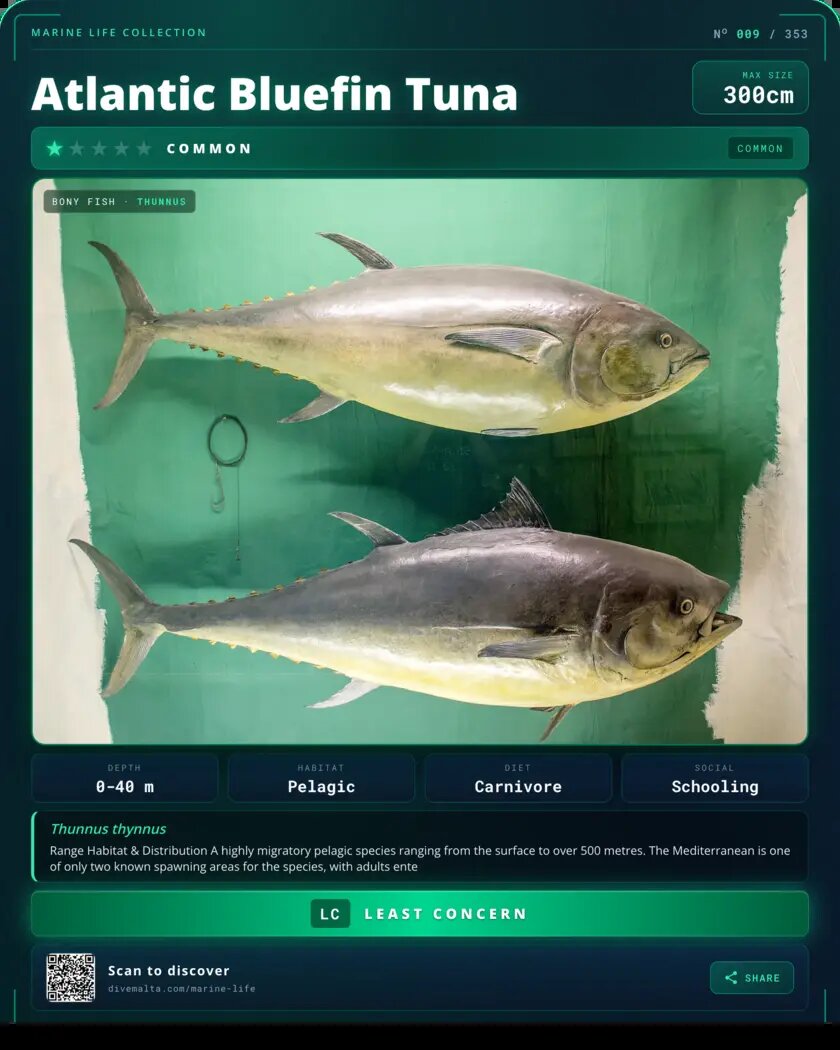
Atlantic Bluefin Tuna species card

Behaviour & Diet

Feeding Strategy

A powerful apex predator that feeds on mackerel, herring, squid, sardines and crustaceans. Capable of maintaining a body temperature above ambient water, giving it a metabolic advantage during high-speed pursuits.

Warm-Blooded Hunter

Reproduction

Enters the Mediterranean specifically to spawn in warm waters between June and July. Females can release up to 10 million eggs per season, though survival rates for larvae are extremely low.

Mediterranean Spawner

Behaviour & Defence

Its enormous size and speed -- reaching 70 km/h -- make adult bluefin virtually immune to all predators except large sharks and orcas. Juveniles school tightly for collective protection.

Apex Size & Speed

Where to Encounter in Malta

Dive sites where Thunnus thynnus may be encountered will be added as sighting data is collected.

IUCN Red List Least Concern

Conservation Status

This species is assessed as Least Concern on the IUCN Red List. Mediterranean populations face ongoing pressure from fishing activity, habitat degradation, and climate-driven changes.

Source: IUCN Red List
diveshack Mediterranean Marine Life guide