Depth
Dalophis · Bony Fish

Armless Snake Eel

Dalophis imberbis

5 - 100 m
Depth Range
150 cm
Max Size
Mediterranean
Distribution
5 - 100 m
Depth Range
150 cm
Max Size
Sandy / Muddy
Habitat
Predator
Diet
Solitary
Social
LC
IUCN Status
Low
Sighting Likelihood
KingdomAnimalia
PhylumChordata
ClassActinopterygii
GenusDalophis
Speciesimberbis

Identification & Biology

  • IdentificationLong, slender, snake-like body without pectoral fins. Smooth skin with no visible scales. Pale brown to yellowish body, sometimes with faint darker spots along the flanks.
  • SizeUp to 100 cm total length, though most individuals are 50 to 70 cm.
  • Social HabitSolitary and secretive. Spends most of its time buried in sandy or muddy substrates with only the head visible.
  • HabitatSoft sediment bottoms including sand, mud, and seagrass beds on the continental shelf and upper slope.
  • Depth10 to 300 m, most common between 20 and 100 m.
  • Feeds OnSmall crustaceans and worms extracted from the sediment.
  • DistributionEastern Atlantic from Portugal to West Africa and throughout the Mediterranean Sea.
  • DescriptionA rarely seen eel that lives almost entirely within the seabed, emerging at night to forage. Its lack of pectoral fins and smooth, scaleless body allow it to burrow efficiently through soft substrates. Divers occasionally spot the head protruding from sand at deeper dive sites.

Habitat & Distribution

Found in sandy and muddy substrates from 5 to 100 m depth across the Mediterranean. A burrowing species that inhabits soft sediment, emerging partially or fully at night to feed.

Where Malta divers have spotted this species

Loading…

Sightings are logged by divers using our What Did You See? dive-log tool. View the full live sightings map.

Detail

Preferred Environment

Sandy and muddy bottoms in coastal to shelf waters. Burrows into soft sediment during the day. Prefers areas of fine to medium sand with sufficient depth of substrate for burrowing. Often near Posidonia meadow edges.

Encounter Tips

Most likely encountered during night dives when it emerges from the sand to hunt. During the day, occasionally found with head and anterior body protruding from the sand. Much larger than the European finless eel.
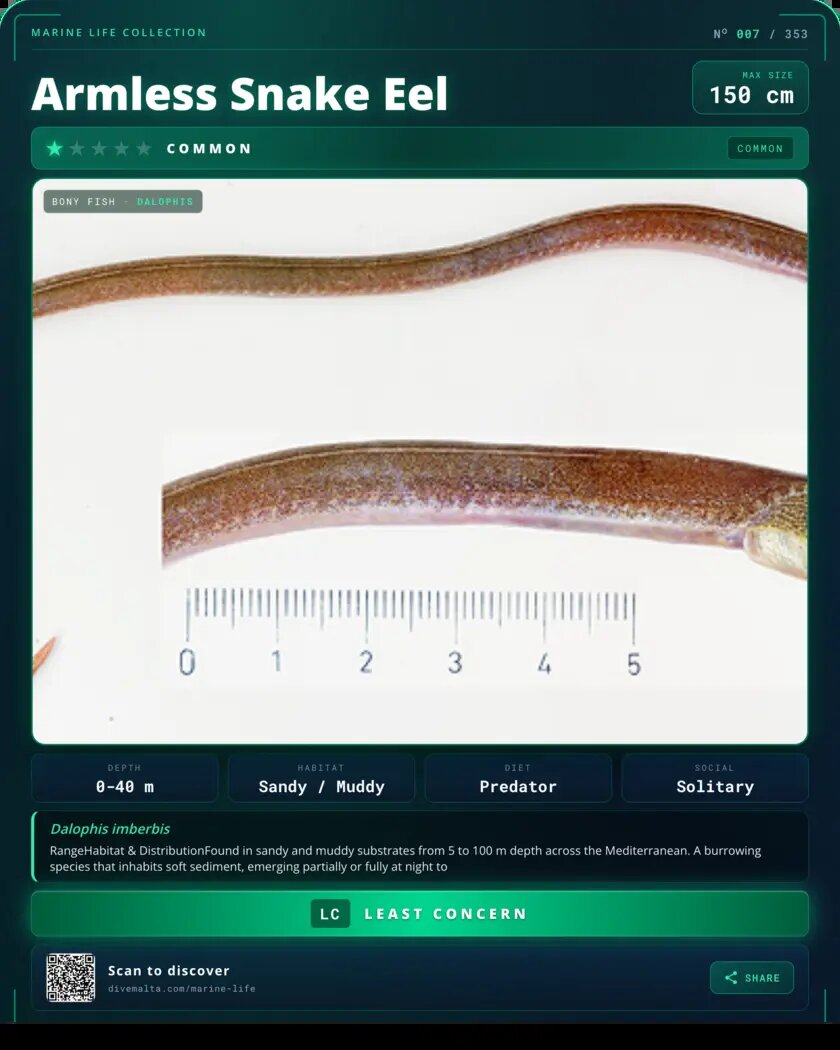
Armless Snake Eel species card

Where to Encounter in Malta

Dive sites where Dalophis imberbis may be encountered will be added as sighting data is collected.

IUCN Red ListLeast Concern

Conservation Status

This species is assessed as Least Concern on the IUCN Red List. Mediterranean populations face ongoing pressure from fishing activity, habitat degradation, and climate-driven changes.

Source: IUCN Red List
diveshack Mediterranean Marine Life guide