Depth
Scyris · Bony Fish

Alexandria Pompano

Scyris alexandrina

5-80m
Depth Range
60cm
Max Size
Mediterranean
Distribution
5-80m
Depth Range
60cm
Max Size
Pelagic
Habitat
Carnivore
Diet
Small groups
Social
LC
IUCN Status
Very Rare
Sighting Likelihood
KingdomAnimalia
PhylumChordata
ClassActinopterygii
GenusScyris
Speciesalexandrina

Identification & Biology

  • IdentificationDeep, strongly compressed body with a very steep head profile. Silver body with a blue-green back. Long, sickle-shaped dorsal and anal fin extensions in adults. Deeply forked tail.
  • SizeUp to 60 cm total length, commonly 25 to 40 cm.
  • Social HabitUsually found in small groups or pairs. Juveniles may form larger schools in coastal waters.
  • HabitatCoastal and offshore waters, often near sandy bottoms and around structures. Juveniles shelter near jellyfish.
  • DepthSurface to 100 m, most common in the upper 30 m.
  • Feeds OnSmall fish, crustaceans, and jellyfish. Juveniles are known to associate with jellyfish for both food and protection.
  • DistributionEastern Atlantic from Portugal to South Africa and throughout the Mediterranean Sea.
  • DescriptionAn elegant, fast-swimming carangid named after Alexandria in Egypt. Juveniles have a fascinating relationship with jellyfish, sheltering beneath their bells and nibbling on their tentacles. Adults are powerful swimmers that cruise reef edges and open sandy areas.

Habitat & Distribution

Inhabits coastal pelagic waters from about 5 m to 80 m depth. Found over sandy and mixed substrates, often near rocky outcrops and around harbours.

Where Malta divers have spotted this species

Loading…

Sightings are logged by divers using our What Did You See? dive-log tool. View the full live sightings map.

Detail

Preferred Environment

Favours warm, shallow coastal waters and semi-sheltered bays. Its presence in the Mediterranean has increased as water temperatures rise.

Encounter Tips

Best approached slowly and calmly. Avoid casting shadows directly over the animal. Neutral buoyancy and patience increase encounter success significantly.
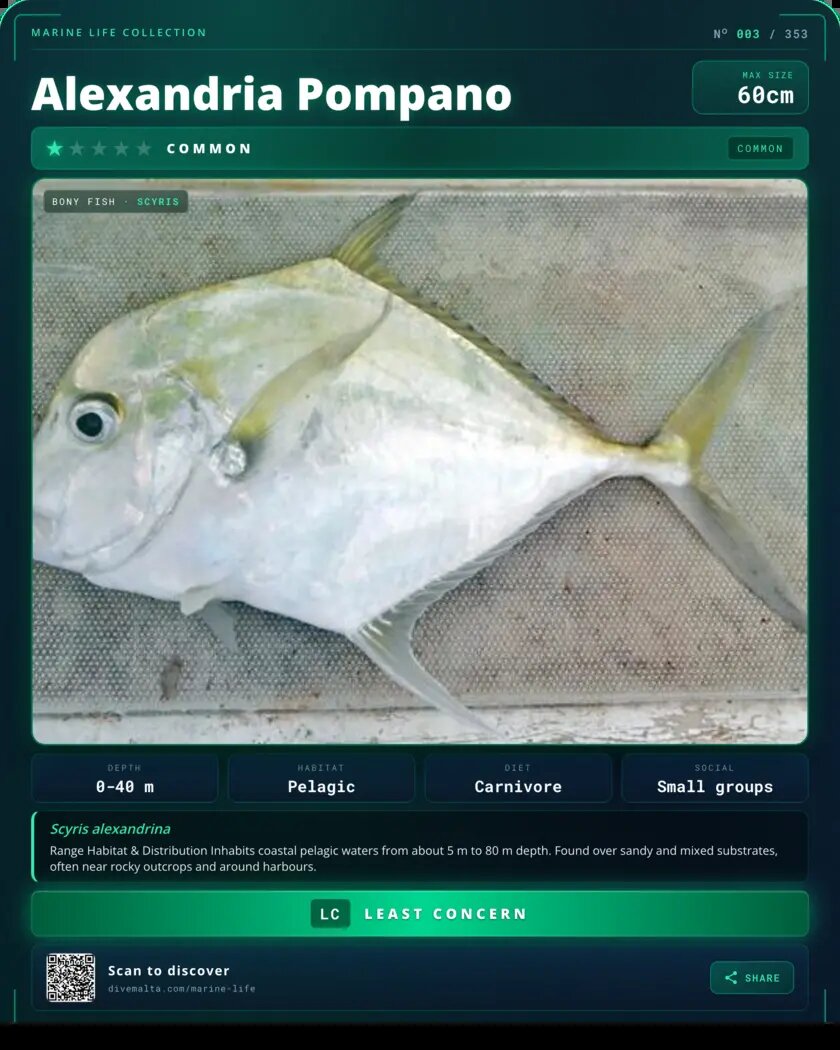
Alexandria Pompano species card

Behaviour & Diet

Feeding Strategy

Preys on small fish and crustaceans in mid-water and near the seabed. Uses short bursts of speed to ambush prey items from below.

Ambush feeder

Reproduction

Spawns in open coastal waters during summer. Eggs and larvae are pelagic, developing in the plankton before juveniles settle inshore.

Pelagic spawner

Behaviour & Defence

Uses its laterally compressed body to make rapid turns and confuse pursuers. The trailing fin filaments may serve as a decoy against predatory strikes.

Agile swimmer

Where to Encounter in Malta

Dive sites where Scyris alexandrina may be encountered will be added as sighting data is collected.

IUCN Red List Least Concern

Conservation Status

This species is assessed as Least Concern on the IUCN Red List. Mediterranean populations face ongoing pressure from fishing activity, habitat degradation, and climate-driven changes.

Source: IUCN Red List
diveshack Mediterranean Marine Life guide